


Product Parameters
|
Model |
12V 100Ah |
12V 150Ah |
12V 200Ah |
12V 230Ah |
12V 280Ah |
12V 314Ah |
12V 400Ah |
12V 628Ah |
| Rated Voltage |
12.8V |
|||||||
|
Nominal Capacity |
100Ah |
150Ah |
200Ah |
230Ah |
280Ah |
314Ah |
400Ah |
628Ah |
| Energy | 1.28KWh | 1.92KWh | 2.56KWh | 2.944KWh | 3.584KWh | 4.019KWh | 5.12KWh | 8.038KWh |
| Size(mm) | 260*168*209 | 330*172*215 | 384*194*255 | 384*194*255 | 384*194*255 | 384*194*255 | 522*240*218 | 640*245*220 |
| Weight |
10 Kg |
16Kg |
20Kg |
23Kg |
29Kg |
30Kg |
40.5Kg |
54Kg |
| BMS Protection Function |
Over charge protection, Over discharge protection, Temperature protection, Balanced function |
|||||||
| Charging Voltage |
14.6V |
|||||||
| Max. Continuous Charging Current |
100A |
150A |
200A |
200A |
200A |
200A |
250A |
250A |
|
Max. Continuous Discharging Current |
100A |
150A |
200A |
200A |
200A |
200A |
300A |
300A |
|
Peak Discharge Current |
200A(3S) |
300A(3S) |
400A(3S) |
400A(3S) |
400A(3S) |
400A(3S) |
600A(3S) |
600A(3S) |
| Charge Temperature |
0-55℃ |
|||||||
| Discharge Temperature |
-20-60℃ |
|||||||
| Storage Temperature |
Within 2 months:-20℃~40℃,Within 6 months:-10-35℃ |
|||||||
| Waterproof Level |
IP65 |
|||||||
|
Optional |
Bluetooth/CAN/RS485/Heating Function |
|||||||
Features
1. Smart BMS: Over-charge, over-discharge, over-current, short-circuit and thermal cut-off are all handled in one board, protecting both the battery and your reputation.
2. 6000+ Deep Cycles: Grade A LiFePO4 cells deliver 6000 cycles at 70% DOD—10 years of daily use.
3. ABS case, with an IP65 waterproof rating
4. half the weight, twice the power of AGM.
5. Ideal drop-in for RV house banks, marine trolling motors and solar storage.
6. Customizable Bluetooth and communication features
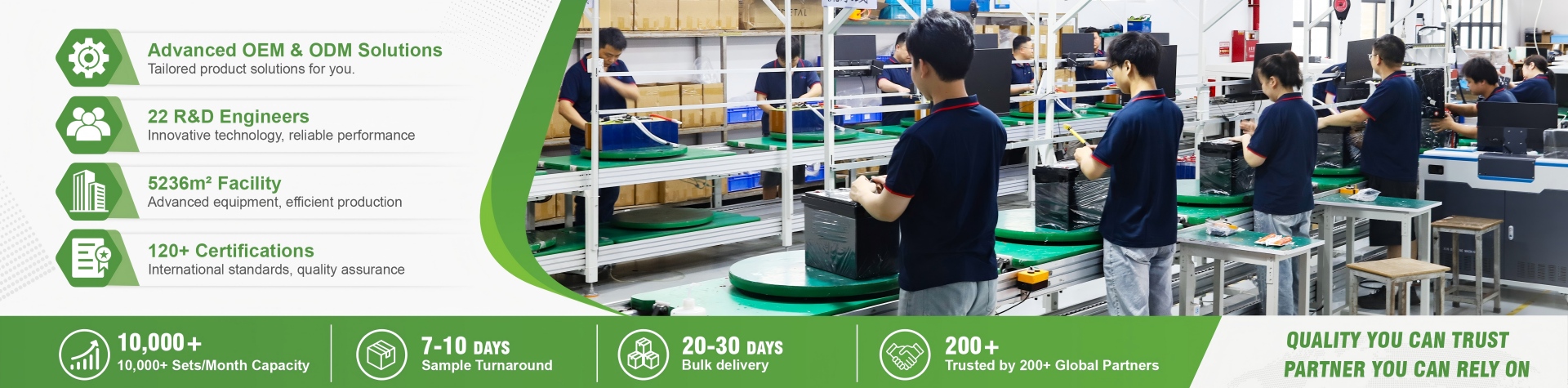
Explore our comprehensive factory capabilities and customized solutions

Applications
This 12V lead-acid battery replacement with lithium iron phosphate technology can be directly installed without modifying the circuit or equipment. With five core advantages including long cycle life, lightweight, high and low temperature resistance, maintenance-free operation, and low self-discharge, it is fully compatible with commercial, industrial, and outdoor energy storage power supply needs in various global scenarios. It is the preferred upgraded power source for overseas bulk purchasing, engineering support, and cross-border distribution.

FAQ
A: Sample orders start at 1 set, with small batches of 50 sets and large batches of 500 sets or more. We understand the needs of partners of all sizes.
A: We can provide customized certificate services for your brand
A: We accept payment for samples, and the sample fee will be refunded upon placement of a bulk order. Sample lead time is 7–10 days
A: Yes. Our in-house BMS supports in-depth modifications such as programming protection parameters, adjusting charge/discharge logic, and customizing communication protocols.
A: 24-month warranty, with a response to after-sales requests within 24 hours, including technical support, returns and exchanges, and repair services.
A: We provide a complete set of certified scanned copies and test report summaries, with UN 38.3 test reports and MSDS documents included for each batch.
1. 100A Smart BMS: Over-charge, over-discharge, over-current, short-circuit and thermal cut-off are all handled in one board, protecting both the battery and your reputation.
2. 6000+ Deep Cycles: Grade A LiFePO4 cells deliver 6000 cycles at 70% DOD—10 years of daily use.
3. ABS case, with an IP65 waterproof rating
4. only 10kg—half the weight, twice the power of AGM.
5. Ideal drop-in for RV house banks, marine trolling motors and solar storage.
6. Customizable Bluetooth and communication features
|
No. |
Customized Project |
Customized Content |
| 1 | Voltage/ Capacity Customization | 12V – 72V, 5Ah – 628Ah full series customization |
| 2 | Size Customization | Can be customized according to the size of the battery compartment in the customer’s product |
| 3 | Interface Customization | Anderson connector, XT90, through terminal, RJ45, etc. customization |
| 4 | Appearance Customization | Customization of LOGO, color, material, and process |
| 5 | BMS Customization | Hardware customization, software customization, CAN/RS485/RS232 customization |
| 6 | Special Function Customization | Heating function customization, APP customization |
| 7 | Packaging & Assembly Customization | Customization of paper boxes, wooden boxes, and instructions |
| 8 | Certification Customization | Customization of target market-specific certifications such as EU IEC62619, US UL |
An exceptional battery pack is not only the result of high-quality cell materials but also depends on a rigorous, precise, and traceable production process system. Today, we are releasing our internal ”Battery Pack Production Process Flowchart” to take you behind the scenes and reveal how a high-quality battery pack passes through layer upon layer of quality checks before it is finally delivered to our customers.
ODIPIE Lithium-Ion Battery Production Process
1. Battery Cell Matching: First, the cells undergo consistency screening and matching to ensure parameters such as voltage and internal resistance are consistent, laying the foundation for subsequent assembly.
2. Cell Insulation: The matched cells undergo insulation treatment, wrapped in epoxy board insulation material to prevent the risk of short circuits between cells.
3. Laser Welding: Using laser welding technology, the cells are securely connected into a pack, ensuring connection stability and electrical conductivity.
4. Data Cable Attachment: Data cables are attached to the welded cell packs to provide signal collection points for subsequent BMS management.
5. Battery Management System (BMS) Mounting: The BMS is securely mounted onto the cell pack to ensure a stable installation and provide the hardware foundation for battery safety management.
6. Positive and Negative Terminal Wiring: The positive and negative terminal wiring of the battery pack is secured and reinforced to ensure stable and reliable current transmission.
7. Battery Insulation: The entire battery pack is wrapped again with epoxy board insulation to further enhance the overall insulation protection rating.
8. Battery Internal Resistance Testing: Conduct internal resistance testing on the assembled battery pack to verify that the internal resistance of the cell assembly meets standards.
9. Battery Aging Testing: Perform long-term charge-discharge aging tests on the battery pack to simulate actual operating conditions and identify early defects.
10. Enclosure Assembly / Securing Positive and Negative Terminals: The battery pack is assembled into the enclosure, and the positive and negative terminals are securely fastened, completing the initial product assembly.
11. Battery Functional Testing: Comprehensive functional testing is performed on the finished battery, including protection functions and communication capabilities, to ensure all specifications are met.
12. Enclosure Sealing: The battery enclosure is sealed to enhance waterproofing and dustproofing performance, meeting the protection requirements of various application scenarios.
13. Vibration Testing: Subject the finished batteries to vibration testing to simulate the vibration environments encountered during transportation and use, verifying the structural stability of the product.
14. High and Low Temperature Testing: Test the batteries in high and low temperature environments to verify their performance and safety under extreme temperature conditions.
15. Packaging / Palletizing: After final inspection, professionally package the batteries and stack them onto pallets to ensure safe delivery to the customer.
From Cell to Finished Product: A Comprehensive Guide to Battery Pack Manufacturing Processes and Rigorous Quality Control
——Precision Control Down to the Millimeter: Crafting High-Safety, High-Consistency Lithium-Ion Battery Products
ODIPIE Lithium-Ion Battery Production Quality Control Process:
1. Order and Material Preparation Control: Once an order is confirmed, a production plan is issued, and material procurement is initiated simultaneously; All materials must undergo incoming quality control (IQC) before entering the facility; non-conforming materials are rejected outright, and only those that pass inspection are stored in the warehouse.
2. First-Article and Process Validation: After material preparation is complete, the first production unit is manufactured and undergoes comprehensive performance testing; simultaneously, process SOPs and industry certification standards are validated. Only when both the first-article and the process meet standards is mass production permitted.
3. Cell Batching and Sorting: Cells are grouped according to stringent standards, requiring a voltage difference of ≤±2 mV and an internal resistance difference of ≤±0.1 mΩ. This ensures cell consistency from the source, laying the foundation for stable battery operation.
4. Assembly and Welding Control: After laser welding of the cells, the tensile strength of the connection tabs (5% random inspection, ≥50 kg) and the lead wires (≥5 kg) is strictly tested. Solder joints on the lead wires must be reinforced with adhesive to eliminate the risk of cold solder joints or solder joint failure.
5. Full-Process Quality Inspection During Assembly: After welding, the cable harness is organized, the BMS (Battery Management System) is secured, and the positive and negative terminals are neatly routed. Simultaneously, the battery pack undergoes multi-layer insulation treatment, with installation accuracy and safety verified at every step.
6. Electrical Performance and Cycle Testing: After the battery pack is fully assembled, first verify that the internal resistance meets specifications; then conduct charge-discharge aging cycle tests (process: discharge to empty → fully charge → discharge to empty → charge to 70% SOC) to screen out early defects and ensure the battery’s cycle life.
7. Functional and Final Inspection: After passing the aging test, a full functional test of the battery is conducted. Following casing, a final visual inspection is performed to ensure no scratches or adhesive overflow, no oxidation on the terminals, and a centered nameplate with no creases; non-conforming products are reworked.
8. Packaging and Shipping Verification: Qualified products are sealed, packed, and arranged on pallets. After warehousing, they undergo a final commercial inspection; once confirmed, shipping is arranged, with the entire process traceable through documentation.

CE

UN38.3/MSDS

RoHS/REACH

IEC62619

UL
Pre-Sales Services
1. Ultra-fast consultation response and professional one-on-one project matching.
2. Complete compliance certification materials to facilitate the compliant implementation of projects.
3. Free customized solutions to meet all scenarios of energy storage needs.
4. Transparent and accurate quotations to strictly control procurement costs.
5. Support for personalized customization of appearance, packaging, and brand.
II. In-Sales Service
1. Sample testing is conducted first. Only after the samples pass the test will the bulk production be initiated, with strict quality control throughout.
2. A WhatsApp group is established upon order placement, with R&D, quality control, and production departments working together to ensure the timely delivery of the order.
3. The order progress is updated in real time, allowing for full visibility throughout the process.
4. The latest logistics updates are provided in real time after the goods leave the factory.
5. Tailored to the overseas market, we offer localized adaptation services.
III. After-Sales Service
1. 3-5 years of long-term warranty, with 24-hour global after-sales response.
2. Free installation guidance, BMS debugging and technical training.
3. Remote fault diagnosis for efficient resolution of after-sales issues.
4. Free provision of promotional materials to empower customers’ market promotion.
5. Long-term technical follow-up and continuous sharing of industry cutting-edge information.


