
If abundance set battery prices, sodium would have won ten years ago. The element is somewhere near a thousand times more common than lithium, every ocean is full of it, and it does not depend on a short list of brine fields.
And yet the sodium cell still quotes higher than the LFP cell beside it.
Worth knowing why before deciding whether that matters to you, because the reason has very little to do with the price of sodium.
Three reasons the arithmetic goes the wrong way
Sodium ions are larger and heavier than lithium ions. Nothing to negotiate there; it is the periodic table. It caps volumetric energy density roughly 20–40% below lithium, and at cell level today nearer 60% of it. Every cost then gets divided by that number. More cathode powder, more anode, more electrolyte, more separator, more foil and more individual cells for the same kilowatt-hour. The cabinet, the cable run and the concrete pad do not shrink to compensate.
Then the anode. Lithium gets to use graphite. Sodium will not intercalate into graphite in any useful quantity, so it needs hard carbon, and there was no large hard carbon industry sitting idle when the sector came looking. The mainstream biomass routes fight three problems that have nothing to do with sodium prices: lumpy feedstock supply, poor batch consistency, and expensive impurity control. Hard carbon has fallen from RMB 60,000–70,000 a tonne in 2024 to roughly RMB 35,000–40,000 now, against a long-term target below RMB 25,000. Real progress. Still the clearest bottleneck in the bill of materials.
Third, and decisively, manufacturing. There is a tidy bit of arithmetic buried in this one. NFPP cathode already costs less than LFP cathode, around RMB 0.09/Wh against RMB 0.12/Wh. Sodium wins that line today. It then loses it four times over in the factory: manufacturing cost runs roughly RMB 0.15/Wh for sodium against RMB 0.03/Wh for mature LFP. That RMB 0.12 gap dwarfs the RMB 0.03 cathode advantage.
The cause is utilisation. The sodium industry is running near 30%, against above 90% at leading lithium plants. Depreciation and labour get spread across far fewer good watt-hours. Only volume fixes it, and most modelling puts the 30–40% manufacturing cost reduction somewhere near 100 GWh of annual market output.
Net result today: roughly RMB 0.45–0.47/Wh for sodium storage cells against RMB 0.34–0.38/Wh for LFP. Call it a 30% premium. Note also that the premium breathes with lithium carbonate, so it is a moving number rather than a fact about either chemistry.
None of this is controversial, and anyone buying on capital cost per kilowatt-hour should be buying LFP.
Where the premium stops being a premium
We build both, so we can say this plainly: there is one dimension where sodium is not merely better, it is in a different category, and that is cold.
Standard LiFePO4 cells cannot be charged below 0°C. That is not a caution on a datasheet, it is a hard constraint. Charging a frozen cell plates lithium onto the anode, and the capacity lost that way does not come back. In practice it means a cold site either fits heaters, then spends energy every winter heating its own batteries, or accepts derated charging and noticeably less usable capacity when it is coldest.
Sodium behaves differently. Its charge acceptance and discharge capacity hold up far better at low temperature, and you are not managing a 0°C charging floor. In cold storage, freezer warehouses, cold chain logistics yards, unheated northern depots, high-altitude sites, or winter RV and marine use, that changes the operating picture rather than nudging it. No heating load. No seasonal derating to schedule around. No heating system as another thing that can fail.
This is why we build sodium packs alongside lithium ones rather than instead of them. Paying 30% more to buy back twenty winters of heating energy and lost capacity is not paying more.
Where each part of the range fits
Our sodium products are deliberately scoped to that logic, not positioned as a blanket LFP replacement.
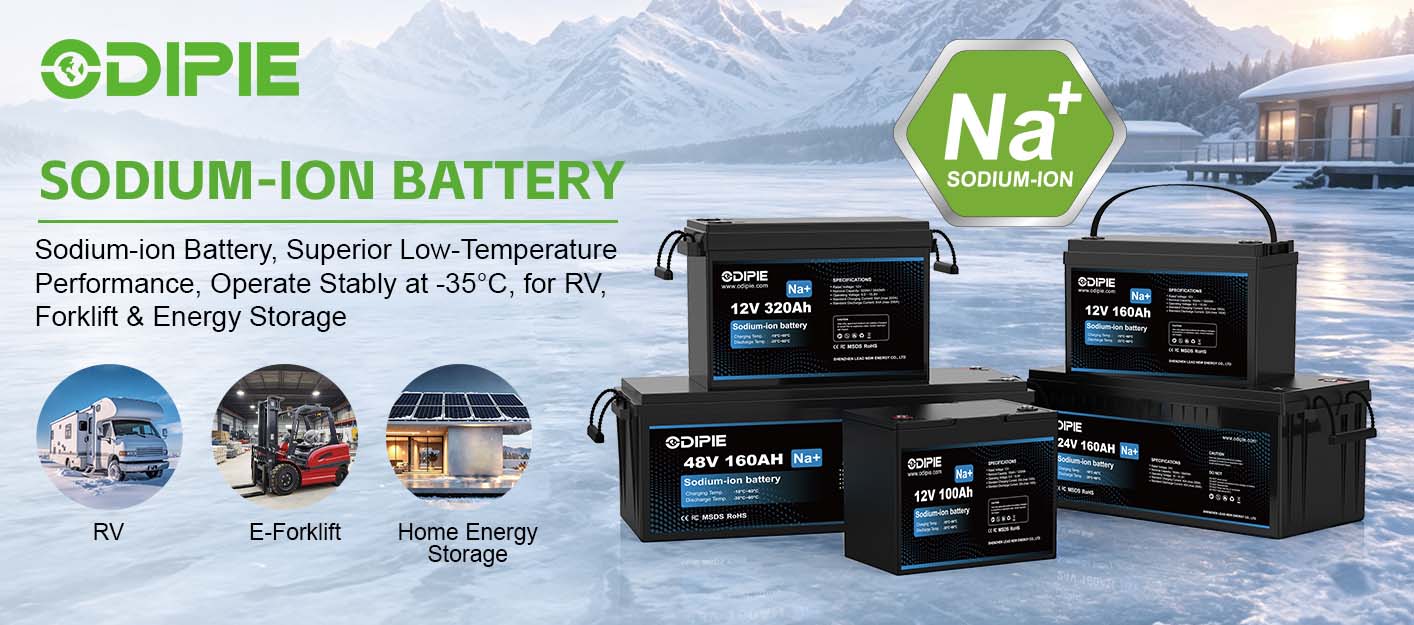
For systems still running lead-acid, the drop-in replacements are 12V 100Ah, 12V 160Ah, 12V 200Ah and 24V 200Ah. Same nominal voltage as the AGM and gel banks they displace, so nothing downstream changes, and lead-acid’s own cold-weather weakness stops being the limiting factor.
For residential and small commercial storage, there is the 48V 200Ah wall-mounted unit, built for households and light installations that see genuine winter rather than a mild damp one.
For materials handling, the industrial line runs 24V 160Ah, 24V 320Ah, 48V 160Ah and 48V 320Ah Sodium-ion Forklift batteries. Cold stores and freezer operations are the obvious fit, since those are environments that are cold by design and where a lithium pack spends its whole life fighting its own temperature limits.
The short version for buyers
Sodium is more expensive today and will likely stay so until utilisation climbs and hard carbon scales. If your site is temperate, installed indoors, and cycled daily, buy LFP. We would rather tell you that than sell you into the wrong chemistry.
If your batteries live below freezing, if you are replacing lead-acid purely because it gives up in winter, or if the alternative is twenty years of paying to heat a battery before you can charge it, the comparison is not cell price against cell price. Ask for usable capacity in January, not kWh on a warm summer commissioning report.
Post time: Oct-27-2026


