
For RV battery brands, distributors and manufacturers, choosing a supplier involves more than comparing voltage, capacity and price. Dimensions decide whether the pack goes into the vehicle at all. A 60038 case measures 358 × 178 × 188 mm; a tray under a campervan seat base often leaves 61 mm of height. Those two numbers are the whole problem.
Standardized LiFePO4 batteries cover the common applications, but they cannot cover every installation. European motorhomes were built around the DIN100 / H8 lead-acid box, North American rigs around BCI Group 49, and Australian off-road builds often put the house bank in an exterior locker where wash-down and corrugations are routine. Even within one model range, the service hatch moves between model years.
For brands building out an RV range, the useful question is whether a factory can change the enclosure and the electronics on the same drawing — 61–82 mm case thickness, terminal position, BMS protocol, sealing level — rather than quote from a fixed catalog.
1. Why Standard RV Battery Sizes Are Not Always Suitable
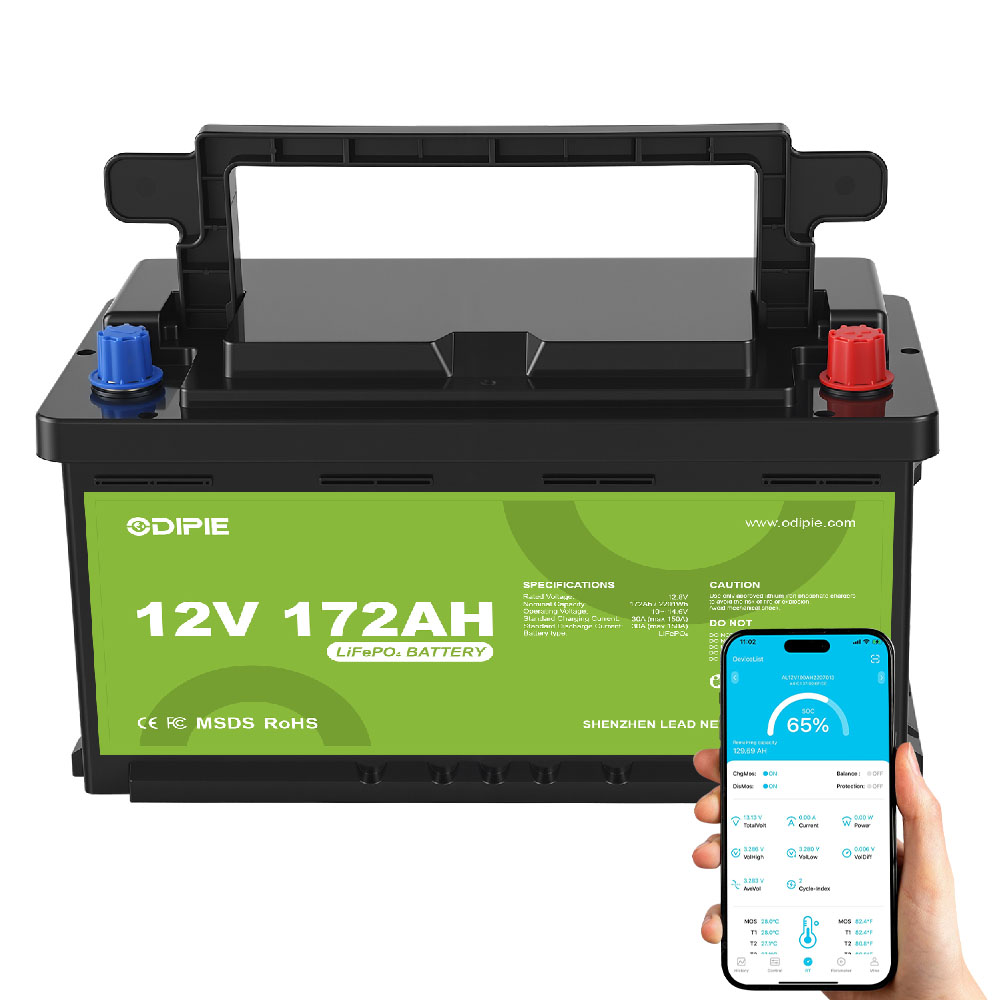
Many RV manufacturers designed their battery compartments around lead-acid batteries. The 60038 footprint is a case in point: 358 × 178 × 188 mm, sold as H8, L5, DIN100 or Group 49 depending on the market, with the hold-down clamp and cable run already fixed around it.
When an owner or conversion shop upgrades to LiFePO4, that envelope becomes the limit. A 12.8V 200Ah pack in a standard box may carry the right capacity and still not pass through the service hatch. Our 12V 150Ah and 172Ah models were built for the 60038 tray for exactly this reason: same footprint, about 16 kg against roughly 28 kg for a filled H8 lead-acid battery, so the tray, clamp and cabling stay where they are.
Where the compartment is shallow instead of deep, the 60038 case is no help at all. Bed slats, seat bases, wheel-arch lockers and sidewall voids generally leave 60–130 mm of height. That is why we run a separate ultra-slim platform: sheet-steel cases 61–82 mm thick with integrated mounting flanges, plus 110 mm, 130 mm and 132 mm formats for bays with more depth.
For a brand, offering only standard sizes means turning away the customer whose vehicle was drawn before the battery was chosen. The gap shows up differently by region: DIN100 replacements in Germany and France, Group 49 swaps in North American pickup campers, and IP-rated, vibration-tolerant packs for exterior lockers in Australia.
2. Five Customization Requirements RV Battery Brands Commonly Face
When a new RV battery product is specified, the same five requests come back. None of them is solved by changing the Ah number on a label.
1. Thinner Battery Enclosures
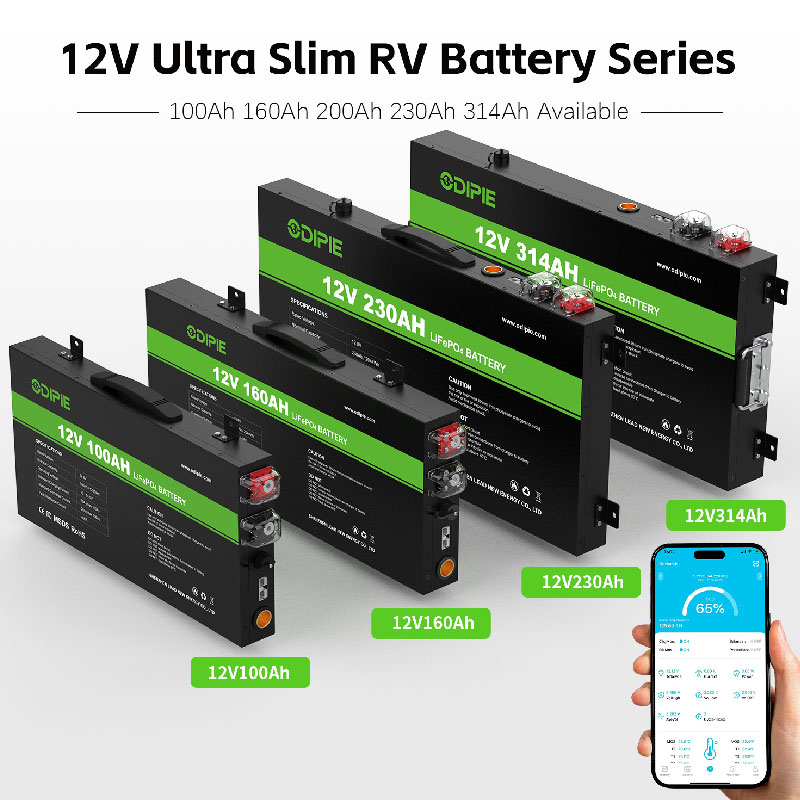
Space is tightest in campervans and compact motorhomes, where vertical clearance, not floor area, sets the limit. Our 12V ultra-slim series runs six capacities on one sheet-steel platform — 100Ah at 61 mm, 160Ah at 69 mm, 200Ah and 230Ah at 62 mm, 280Ah and 314Ah at 82 mm — with mounting flanges formed into the case so a 30 kg pack bolts to structure instead of being strapped to a shelf. The 200/230Ah pair shares one shell and the 280/314Ah pair another, so one compartment cut-out covers two trim levels.
2. Higher Capacity Within Limited Space
Onboard loads have grown: rooftop air conditioning, compressor fridges, induction hobs, inverters. More cells normally mean a bigger box. In our range the 314Ah slim pack holds 4,019Wh in 82 mm at 200A continuous and 500A peak; the 12.8V 392Ah model holds 5,017Wh in a case that still drops into a standard battery box; and the 60038 platform puts 150Ah (1,920Wh) and 172Ah (2,202Wh) into the original lead-acid footprint. Getting there is a cell-layout, busbar and thermal-path problem, not a capacity setting.
3. Customized Terminals and Mounting Positions
Terminals are not in the same place across RV platforms. On the 60038 family we supply either automotive post or stud terminals to match the original battery in the customer’s market. Across custom builds we fit Anderson, XT90, stud or RJ45 connections and move the cable exit to suit the drawing. One detail worth putting on the drawing: on the 200/230/280/314Ah slim packs the case is 730 × 370 mm, but the with-terminals envelope is 730 × 400 mm. Those 30 mm decide whether a floor plan works.
4. Waterproofing and Vibration Resistance
Exterior lockers and chassis positions see vibration, gravel, hose-down and wide temperature swings. The slim series uses a sheet-steel enclosure with bolted flanges rather than a plastic box held by a strap. Sealing is specified per platform, not quoted once for a whole catalog: the standard 12.8V range is IP67, the 25.6V 230/280/314Ah models are IP65, and the ultra-slim sheet-steel cases are confirmed against the project drawing. Charge range is 0–55°C and discharge -20–60°C; for Nordic and inland-Canadian programs, BMS-controlled heating films let the pack accept charge at -20°C ambient.
5. Replacement Solutions for Existing Lead-Acid Compartments
Most owners want the lithium upgrade without cutting the tray. The 60038 models are the answer here: 358 × 178 × 188 mm, 12.8V nominal, 150A continuous, Bluetooth readout of SOC, voltage, current, temperature and cycle index, and up to four units in series for a 51.2V bank. The charger profile still needs to be lithium-compatible — that is the one change the installer has to make.
3. Why ODM Capability Matters More Than a Standard Product Catalog
A supplier can list dozens of standard models and still have no way to move a terminal. Product variety is not customization capability.
What matters is whether the manufacturer can turn an installation requirement into a buildable pack. Changing case height changes cell arrangement, busbar length, thermal path and where the BMS board sits. Moving a terminal changes the harness and the service clearance. Adding self-heating changes BMS firmware and charge limits. Structural and electrical decisions arrive together; quoting them as separate line items usually means neither has been costed properly.
Our configurable envelope is 12–72V and 5–628Ah, with hardware or software BMS work, CAN, RS485 and RS232, heating, app customization, and a choice of Anderson, XT90, stud or RJ45 interfaces. Enclosure dimensions, material, color, logo, rating print, carton and manual are set on the first order. Certification support is scoped by market — IEC 62619 for EU-related requirements, UL processes for the US — and UN38.3, MSDS, CE, FCC and RoHS documents are issued per batch.
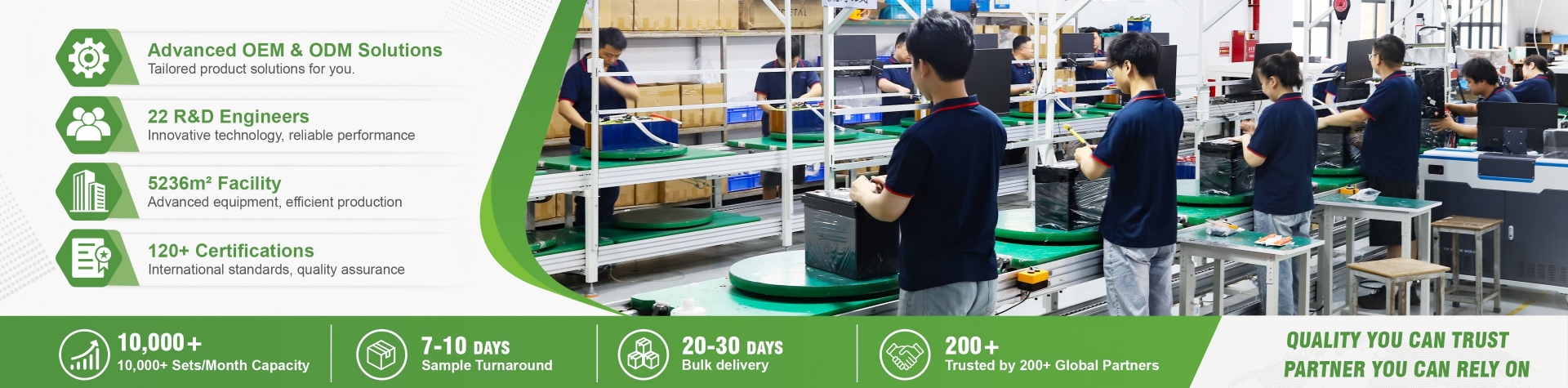
The engineering side is staffed rather than outsourced: eight senior R&D engineers, two invention patents and 22 utility model patents. Custom programs start at 100 units. We return a proposal within 24 hours of a compartment drawing and load list, build samples for testing, then move to production in about 20 days; stock models ship in roughly three. A factory that accepts a new enclosure, a new protocol and a new terminal layout in one reply without asking a question has not understood the request.
The point of that process is consistency. The case changes; the BMS platform, the test records and the documentation set don’t.
4. How ODIPIE Supports Custom RV Battery Development
At ODIPIE we build both sides of the range. The standard side covers 12.8V packs from 100Ah to 628Ah — including the 60038 150/172Ah drop-in models, self-heating versions at 100/200/314/400/628Ah, 12.8V 356Ah and 392Ah high-energy packs, 24V/25.6V from 100Ah to 314Ah, and a 51.2V 100Ah pack. The slim side covers the six 61–82 mm capacities and the 110/130/132 mm formats.
As a LiFePO4 manufacturer, we supply these as catalog products or as starting points for OEM/ODM development. For projects that need changes, the specification sheet we work from looks like this:
Battery Dimensions — length, width and height against the compartment drawing. Existing platforms: 60038 at 358 × 178 × 188 mm, sheet-steel slim cases at 61/62/69/82 mm, and 110/130/132 mm formats. Case tolerances are confirmed in writing before tooling.
Enclosure Design — sheet steel with integrated mounting flanges for locker and chassis positions, or ABS for protected interior bays; sealing level specified per platform rather than assumed.
Electrical Configuration — 12–72V and 5–628Ah, charge and discharge current, hardware or software BMS, CAN / RS485 / RS232, Bluetooth and app, self-heating.
Terminal Layout — automotive post, stud, Anderson, XT90 or RJ45, with terminal position and cable exit set by the drawing. We issue the with-terminals envelope alongside the case dimensions.
Protection Requirements — IP67 or IP65 by platform, vibration-tolerant mounting, -20–60°C discharge, low-temperature charge cut-off or heating where the market calls for it.
Branding and Documentation — logo, color, material and finish, nameplate and model numbering, cartons, wooden crates, labels and manuals; UN38.3, MSDS, CE, FCC and RoHS per batch, with market-specific certification handled by project scope.
Our engineering team reviews the compartment drawing, the load list and the destination market before quoting feasibility. Sample testing comes before mass production. That gives a distributor one part number per installation type instead of one compromise pack listed against ten competitors.
It also lets a brand tier a range by installation: 60038 drop-in for the replacement business, 61–82 mm slim for seat bases and sidewall voids, heated packs for cold climates, and protocol-matched packs for a specified inverter or MFD.
5. Build a More Competitive RV Battery Product Line
The RV lithium market is not only a race to more Ah at a lower price. A 61 mm tray, a Group 49 hold-down and an IP67 exterior locker are three different products, and the brand that can list all three is harder to compare on a price table.
For battery brands, a manufacturer with real ODM capability closes the gap between a standard catalog and the vehicle that is actually in the workshop. Instead of limiting a portfolio to conventional dimensions, you can build a drop-in replacement line, an ultra-slim line from 100Ah to 314Ah, and custom configurations for specific platforms — on the same BMS platform, with the same documentation set.
Looking for an RV lithium battery manufacturer that can support your product development requirements?
ODIPIE provides standard and customized LiFePO4 battery solutions for RV battery brands, distributors and OEM partners.
Contact our team to discuss your battery compartment dimensions, capacity requirements and installation conditions. Let’s develop an RV battery solution that fits your product strategy.
Post time: Nov-27-2026


