


LiFePO4 batteries are widely used in RVs, motorhomes, and campervans because they offer a combination of high usable capacity, relatively low weight, and long cycle life. For many RV owners, upgrading from lead-acid batteries to lithium is a way to run more appliances, spend longer periods off-grid, and reduce the need for frequent battery replacement.
However, even a well-built LiFePO4 battery will gradually lose capacity over time. The rate of degradation depends not only on cell quality but also on how the battery is charged, discharged, installed, and stored.
Some of the problems we see in RV battery applications are not necessarily caused by defective batteries. In many cases, they are related to charging equipment, operating conditions, or system configurations that have not been properly matched to the battery.
Charging LiFePO4 Batteries Below Freezing
Cold weather is one of the operating conditions that RV lithium battery users need to pay particular attention to, especially in regions where winter camping is common.
LiFePO4 cells generally should not be charged below 0°C (32°F) unless the cell or battery manufacturer specifically allows it. At low temperatures, lithium-ion movement becomes less efficient, and charging under unsuitable conditions may lead to lithium plating on the anode. This can cause irreversible capacity loss and, under certain circumstances, increase safety risks.
The problem is easy to overlook. An RV may be parked outdoors overnight, with the battery temperature dropping below freezing. The following morning, the owner connects shore power or starts the solar charging system without knowing the actual cell temperature.
A low-temperature charging protection function in the BMS can prevent charging when the battery temperature is outside the permitted range. For RVs used in colder climates, a self-heating battery is another practical solution. It warms the cells before charging is permitted, allowing the battery to operate more conveniently in cold environments, provided the system is designed for those conditions.
For battery suppliers serving the North American and European RV markets, low-temperature charging capability is worth considering when developing products for winter camping and year-round use.
Repeatedly Running the Battery Down
LiFePO4 batteries can support relatively deep discharge compared with traditional lead-acid batteries. Nevertheless, repeatedly running a battery down to its low-voltage cutoff is not necessarily the best operating practice.
The BMS low-voltage protection is designed to prevent the cells from operating beyond their permitted voltage limits. It is a protective measure, not a recommended daily operating target.
In an RV, the battery may power an inverter, refrigerator, lighting, water pump, heating equipment, and other appliances simultaneously. When the battery bank is undersized for the actual energy demand, users may find themselves relying on nearly the entire available capacity every day.
The battery may still function within its specifications, but operating conditions, discharge current, temperature, and depth of discharge all influence its aging rate.
Proper battery sizing can help avoid this situation. Instead of calculating capacity based only on the total wattage of appliances, RV system designers should consider daily energy consumption, expected off-grid duration, inverter loads, and the charging sources available.
A battery bank with sufficient capacity provides more flexibility and reduces the need to push the system toward its operating limits.
High Temperatures Can Accelerate Battery Aging
Heat is another factor that should not be overlooked, particularly when batteries are installed in confined spaces.
RV batteries are often installed under seats, inside storage compartments, or in enclosed battery cabinets. These locations may have limited airflow, and the temperature can rise considerably during summer travel or when other electrical components are operating nearby.
Elevated temperatures accelerate chemical aging inside lithium cells. Prolonged exposure to heat can gradually reduce battery capacity and increase internal resistance, even when the battery is not being heavily discharged.
The installation location therefore deserves attention during RV electrical system design. A battery should not be placed too close to heat-generating equipment unless the installation conditions are suitable. The manufacturer’s temperature limits should also be considered when designing the battery enclosure and ventilation arrangements.
For RV manufacturers and battery integrators, installation conditions are part of battery performance, not simply a matter of packaging.
Using Charging Equipment That Is Not Properly Configured
An RV’s charging system may include a shore power charger, a DC-DC charger connected to the alternator, and a solar charge controller. All three can affect battery performance.
Problems may arise when equipment originally designed for lead-acid batteries is used with LiFePO4 batteries without checking its charging profile. Some chargers include equalization or maintenance functions that are unsuitable for lithium batteries. Others may have charging voltages or temperature compensation settings that need adjustment.
In a properly configured system, the charging voltage, current limit, and charging profile should be consistent with the battery manufacturer’s specifications.
This is particularly important for customized RV battery projects. A battery may fit the installation space and provide the required capacity, but if the charging equipment cannot be configured correctly, the system may still experience charging interruptions or unnecessary protection events.
Compatibility should be confirmed before installation rather than after the battery has been integrated into the RV.
Excessive Discharge Current and Poor Load Management
A high-capacity battery does not automatically mean that it can handle every electrical load in an RV.
High-power inverters are increasingly used to operate induction cooktops, microwaves, coffee machines, air conditioners, and other appliances. Depending on the system voltage and inverter power, these loads can demand substantial current from the battery.
For example, a 2,000W inverter operating from a nominal 12.8V battery requires considerably more than 150A from the battery under full load once inverter losses are taken into account.
If the battery’s continuous discharge rating, BMS, wiring, or connections are not designed for this demand, the system may experience excessive heating or BMS overcurrent protection.
Repeatedly operating close to the battery’s maximum current rating is also worth avoiding where possible. Selecting a battery with appropriate discharge capability and ensuring that cables, terminals, fuses, and inverter specifications are properly matched can make a significant difference to system reliability.
For OEM customers, these requirements should be evaluated together rather than treating the battery as an isolated component.
Leaving the Battery Unused for Months
Many RVs are used seasonally. During winter, or when an RV is parked for several months, the battery may remain unused for an extended period.
Storage itself is not a problem for LiFePO4 batteries, but the storage conditions matter. Leaving a battery fully charged in a hot environment for months may accelerate aging. Leaving it nearly empty can be equally problematic if the voltage continues to drop during storage.
Even when the battery is disconnected from external appliances, the BMS may consume a small amount of power. Certain RV systems may also have standby loads that are not immediately obvious, such as monitoring devices or control modules.
Before long-term storage, unnecessary loads should be disconnected and the battery should be prepared according to the manufacturer’s storage recommendations. Its state of charge should also be checked periodically, particularly when the RV is stored for several months.
This is a simple step that can help prevent a battery from being left at an excessively low voltage for an extended period.
Poor Installation and Electrical Connections
Battery installation quality is sometimes overlooked when discussing battery lifespan, but it can affect both performance and reliability.
Loose terminals, improperly crimped cables, undersized wiring, and poor connection quality can increase resistance and cause localized heating. These issues become more significant in RV applications, where vibration and movement are part of normal operation.
For battery banks connected in parallel, cable lengths, connection arrangements, and battery compatibility should be considered to help achieve balanced current distribution. The manufacturer’s instructions should be followed when connecting batteries in parallel or configuring a larger battery bank.
Mechanical mounting is equally important. Batteries should be securely installed to withstand movement during travel, and the enclosure should provide appropriate protection against moisture, dust, and other environmental conditions.
Regular inspection of battery connections and mounting hardware can help identify problems before they lead to unexpected power interruptions.
Battery Lifespan Depends on the Entire Power System
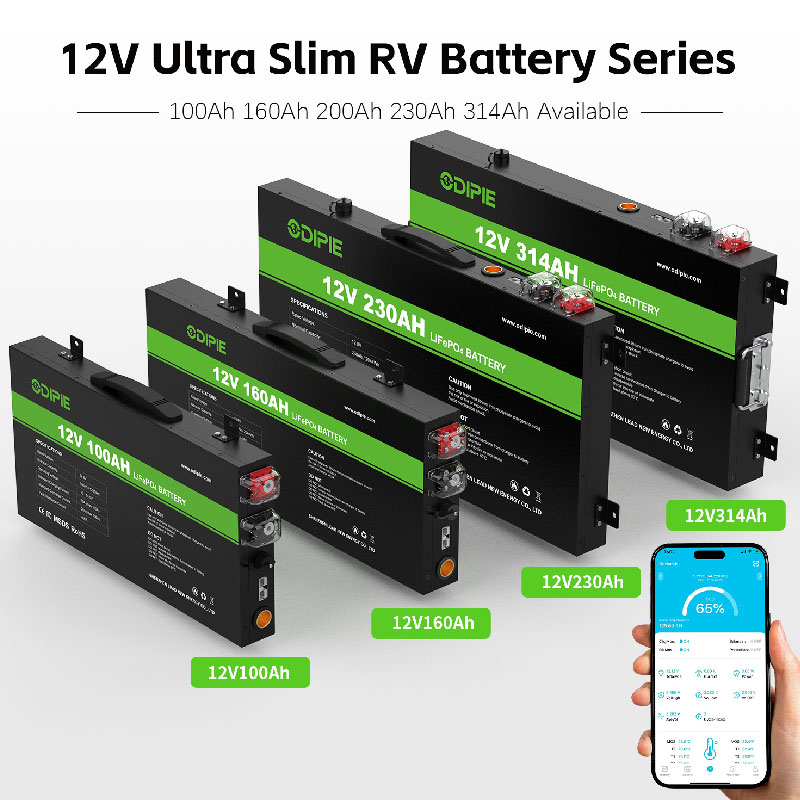
The lifespan of an RV LiFePO4 battery is influenced by a combination of factors rather than a single operating habit. Charging temperature, charging profile, discharge current, storage conditions, and installation quality all contribute to long-term performance.
For RV battery brands, distributors, and manufacturers, these considerations also highlight the importance of choosing a battery supplier that understands RV electrical system requirements.
At ODIPIE, we develop and manufacture LiFePO4 batteries for RV, marine, and off-grid applications. Our OEM/ODM solutions can be tailored to different installation requirements, capacities, BMS functions, and communication needs.
If you are sourcing RV lithium batteries for your brand or product line, contact our team to discuss your application and customization requirements.
Post time: Nov-20-2026


