

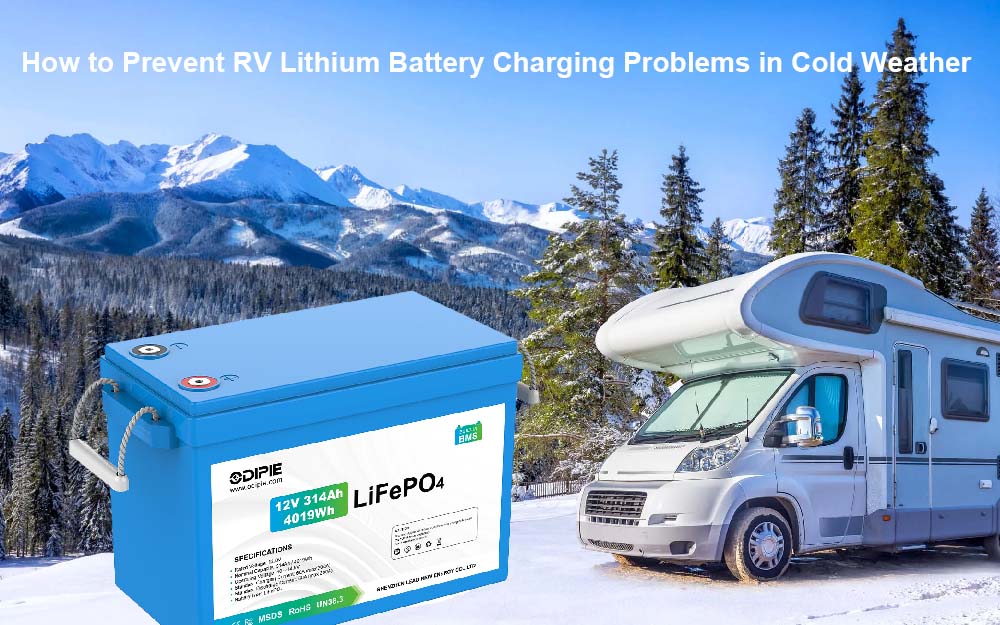
Six in the morning, minus six, ski carpark. The solar controller wakes up, panel voltage comes up fine, and the fridge has been running all night. Nothing goes back into the battery. The owner opens the app, sees 40% and a charge current of zero, and rings the dealer.
The battery isn’t faulty. The BMS is refusing the charge, and it’s right to.
What cold actually does to a LiFePO4 cell
Charging a lithium cell below freezing doesn’t move lithium ions into the anode the way it should. They plate out on the surface as metallic lithium instead. That plating is not reversible. It takes lithium out of circulation permanently, so the capacity is gone, and in the worst case it grows into dendrites that can breach the separator.
That’s why under-temperature charge protection exists on every serious BMS, including ours. On the platform we build, the charge path is cut at roughly 0°C — spec band −3°C to +3°C, 0°C typical — and restored at 2–8°C. An alarm trips earlier still, at 2–8°C, so the owner sees it coming in the app rather than discovering it afterwards.
Discharging is a different matter entirely. Our packs discharge from −20°C to 60°C, and at −20°C they still deliver at least 70% of rated capacity at 1C. Lights work, the diesel heater starts, the fridge keeps running. That asymmetry is what catches people out: the battery looks completely healthy right up to the moment you try to push energy back into it.
Three ways this shows up in a real camper
Solar at first light. The coldest hour of the day is also the hour the array starts producing. Panel voltage is fine. Cells are at −5°C. The controller logs float and goes back to sleep, and the fridge spends another hour taking energy out of a pack that cannot be refilled. On a pack with no heating there is no way out of this loop: the array is a charge source, the cells are too cold to accept it, and nothing in the system is warming anything.
DC-DC charging on the highway. An alternator is the most reliable charge source an RV has, and in winter it’s the one owners trust most. If the battery lives in an external locker or under the chassis, it sits in a 90 km/h wind chill for four hours. It arrives colder than it left.
Shore power in unheated storage. Plugged in for a week, charger connected the whole time, state of charge quietly drifting down from parasitic loads. The charger is attached, so the owner assumes the pack is being maintained. It isn’t. It has never crossed the threshold.
Four fixes, ranked by whether they work unattended
Heat the cells. The only option that works while nobody is watching. More on doing it properly below.
Move the battery into the living space. Genuinely effective, and usually not available. The compartment was designed around a lead-acid box years ago and the floor plan is signed off.
Insulate the compartment. Worth doing, widely misunderstood. Insulation slows heat loss; it does not create heat. A well-insulated box keeps a pack warm overnight if it was warm when you parked. It will not warm a pack that started cold.
Trickle-charge below freezing and hope the BMS is lenient. Some BMS designs permit low-current charging under 0°C. We don’t recommend it, and it’s not something to build a product program around. The plating risk doesn’t vanish because the current is small. It just accumulates more slowly, across more trips.
The part that never makes it onto the spec sheet
This is where most “heated battery” claims fall apart. A supplier answers yes to “does it have heating?”, and the questions that actually decide the outcome — how much heater, where it sits, and what switches it on — never get asked.
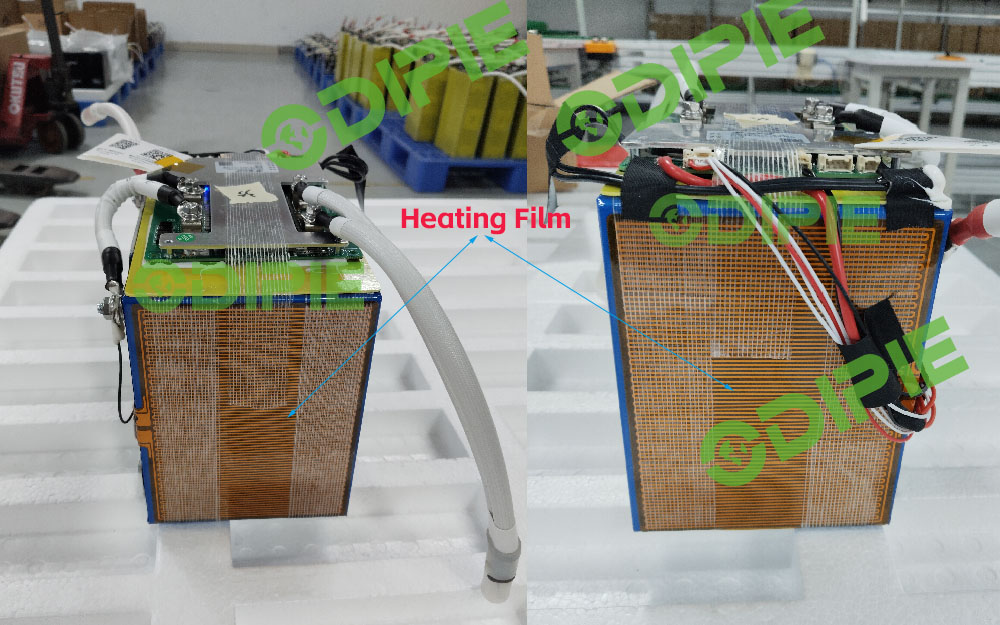
Our 12V packs are four prismatic cells in series. We fit five heating films, each cut to the full face area of a cell.
Five, not four, because four cells sit in a row and the end cell has one face turned toward the case wall. That face is the fastest path to cold. Cover only the four internal faces and the end cell lags — and because the BMS governs charge permission on the coldest sensor in the pack, one lagging cell blocks all four. The fifth film costs very little. Leaving it out is the difference between a pack that accepts charge in twenty minutes and one that doesn’t accept it at all.
The common cost-cutting version is one or two small pads bonded somewhere in the middle of the stack. It reads as “heating” on a quotation. What it does in practice is create a warm patch, leave the outer cells cold, and hand the BMS a perfectly good reason to refuse. You also get a temperature gradient across the pack, which is its own long-term problem: cells at different temperatures age at different rates and drift out of balance.
Uniformity matters more than wattage. A 100W pad in one corner heats one corner. Five full-face films spreading the same power bring the whole stack up together, reach the charge threshold sooner, and do it on less energy.
When the heater comes on
Coverage is half the answer. The other half is the activation logic, and it’s the part nobody asks about.
Two conditions, and both have to hold: a charge source is connected, and the cells are below roughly 0°C. Neither one alone does anything. A cold pack with nothing plugged in just stays cold. A pack at 15°C with a charger on it just charges.
Our packs run this on a JBD protection board, and the sequence goes:
1. Charger connected, cells at −6°C. Heating switches on. Charging stays blocked — the charge path is cut, because the pack is cold.
2. The stack warms from the outside in, and the coldest sensor climbs.
3. At about +5°C the heating stops and the charge path is restored. Charging begins on its own. Nobody presses anything, nobody re-plugs.
4. From there the pack behaves like any other: full current in, up to the 55°C upper limit.
That +5°C isn’t arbitrary. It sits inside the BMS’s own charge-release band — 2 to 8°C, 5°C typical — so the heater hands over at precisely the point the pack is allowed to accept current. No dead zone where the pack has spent energy getting warm and still can’t take a charge.
It’s worth saying what this buys you commercially, because it’s the answer to a support call. The heater runs only while the pack is cold, and only while something is connected. A unit in winter storage with nothing attached sits there and gets cold — it won’t quietly trickle itself flat staying warm. It waits, and it heats the moment somebody plugs in.
One caution on wording when you compare suppliers. Heating moves the cells into the window where charging is allowed. It does not move the window. The cell-level limits stay at 0°C to 55°C: below freezing the anode plates lithium instead of absorbing it, and above 55°C the electrolyte side reactions accelerate. Charging is held 5°C tighter at the top than discharging — 55°C against 60°C — for the same reason. Pushing current in stresses a cell harder than pulling it out.
So a heated pack is not a trick that lets you charge a frozen cell. It’s a pack that refuses to stay frozen long enough to matter. It does nothing at the top end either: at 58°C ambient you want airflow and standoff from the fridge duct, not a heater. If a supplier tells you heating raised the cell window to −20°C, walk away — either they don’t understand their own product or they’re selling cells that will plate.
Two more things worth settling when you specify it:
Charger sizing. Because the films draw from the charging source, the first amps of the day go into the heater rather than into the cells. If a dealer pairs a heated 200Ah pack with a 10A charger, tell them to go up a size. Otherwise the customer gets a pack that warms slowly and then charges slowly, and blames the battery.
Which sensor decides. Coldest-cell logic, not an average. Averaging lets one warm cell carry a cold one over the line.
What to ask a supplier before you sign
Most of these are one-line questions. The answers separate a heated pack from a heated-sounding pack.
| Ask for | Why it matters |
| A heating-film layout drawing | Coverage and position. “Yes, heating” is not an answer. |
| Film count and dimensions vs cell face | Whether the outer cells are covered at all |
| NTC positions, and which one governs charging | Coldest-cell logic or an average |
| Heating activation condition | Both, not either: a charge source connected and cells below the start threshold. Heating only, no charging yet |
| Stop threshold, and what happens next | Ours: off at ~+5°C and charging starts on its own, with no reconnect |
| Communication | CAN / RS485 / Bluetooth, with Victron Cerbo GX and mainstream inverter compatibility — so the owner can read cell temperature instead of guessing |
Where it earns its money
Canada is the obvious one. Winter capability is the single biggest differentiator in that market, and a properly heated pack turns a cold-climate range from a liability into a selling point. Northern Europe and the alpine regions are the same story with different vehicles: motorhomes and campervans used through ski season, not just summer. Add the South Island of New Zealand, the northern US states, and any rental fleet that operates year-round — a fleet can’t afford a battery that sits idle for four months.
The trap is programs that ship to both climates. A range selling into the Gulf and into Alberta needs the heating decision made at specification time. Retrofitting it after the container lands is not a thing.
Short version
A cold LiFePO4 battery that won’t charge isn’t a fault. It’s a protection doing its job, and the correct response is to get the cells above freezing before asking them to accept current. Whether that takes twenty minutes or never happens depends on two things that rarely make it onto a datasheet: how much of each cell a heater actually covers, and what persuades it to switch on.
Our heated 12.8V packs — 200Ah and 280Ah — run the full-face film layout and the JBD logic described above as standard. Datasheets, film layout drawings and low-temperature test data are on www.odipie.com.
Quick questions we get
Can I still discharge a frozen battery? Down to −20°C, yes. Capacity drops — expect around 70% of rated at −20°C and 1C — but loads run fine. Charging is the restricted direction.
How long does heating take? Depends on pack mass, starting temperature and how much spare power the charger has. Full-face coverage is what makes that number short. Ask for the curve, not a single figure.
Can heating be added to a pack I already bought? Not practically. Films are bonded to the cells during assembly. Specify it on the order.
Does heating drain the battery? No. It only starts when a charge source is connected, and it draws from that source. A pack in winter storage with nothing attached sits cold and waits. Which is also why a flat pack discovered in spring is never the heater’s fault.
So should it stay plugged in over winter? If the pack is heated, yes — that’s the one arrangement where the heater has something to draw from when the temperature drops. On an unheated pack, leaving it plugged in below freezing changes nothing but the temperature of the locker.
Looking for reliable heated LiFePO4 batteries for your RV battery lineup?
Contact Odipie for OEM/ODM solutions and factory-direct pricing.
Post time: Oct-30-2026


