
Choosing an RV lithium battery OEM manufacturer is not a decision you can undo cheaply. The quotation shows a unit price. It doesn’t show what happens in year three, when a batch starts coming back from customers two continents away.
Workshops that assemble LiFePO4 packs are everywhere. What is scarce is a factory that holds the same cell quality on the twentieth batch, will build to a drawing you send instead of its own catalogue, and still answers the phone a year after the invoice is paid.
Eight checks worth making before you sign anything. They are also the checks we expect to be held to.

1. Verify the Manufacturer’s Production Capabilities
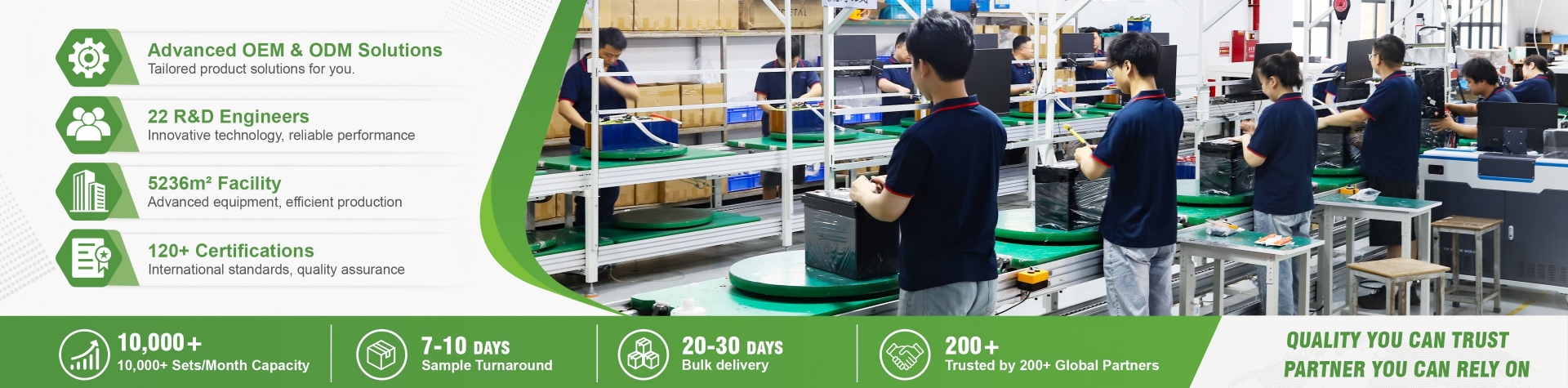
First, find out who physically builds the pack. Some suppliers own lines; others broker the work out to third-party plants. Buying from the party that owns the line keeps the chain short, so your question reaches an engineer instead of a sales inbox forwarding it to a plant you’ve never set foot in.
Nothing on this list is exotic, but each item is easy to fake. Assembly lines and equipment actually in use: ask for a walk-through rather than a photo set. Engineering and QC staff on the payroll. Written inspection and testing procedures with records you can sample. Monthly capacity quoted in packs rather than cells. Material traceability that runs from incoming cells to finished serial numbers.
An hour on the line beats a week of email. Photographs are chosen; a walk-through is not, and that’s the difference. Housekeeping, work-in-progress control, how operators handle a rejected cell: all of it shows. Owning a factory, by the way, proves less than it sounds. The real question is how much of the process the supplier controls, from cell purchasing to final test.
2. Check Cell Quality and Batch Consistency
Cells set the ceiling on capacity, internal resistance, cycle life and safety, and no amount of assembly care fixes a bad cell. Grade A is a phrase any trader can type into a quotation. Ask which cell maker, which channel, how the incoming lot is checked, and how batches are kept apart on the shelf, usually by date code and cell maker.
A factory that tests incoming cells can describe the procedure from memory. Voltage, capacity, internal resistance, measured and logged before assembly starts.
Batch-to-batch drift is the quiet failure. Change the cell specification or the component supplier between runs and performance moves with it. Private-label brands usually meet that drift months later, as warranty claims from customers who can’t tell whether the fault was yours or the installer’s.
Prefer new, unused cells from established makers, written incoming inspection, and a change-control process you can point to. Ask who signs off a substitution, and whether you hear about it before or after.
3. Evaluate BMS and Communication Capabilities
The BMS decides how the pack behaves once it is wired into a vehicle. An RV electrical system is an inverter, a solar controller, a DC-DC charger and a shunt sharing one bus, and a pack that behaves on the bench can still throw a CAN fault the first afternoon it spends in a vehicle.
Five things decide whether the pack survives its first season. Protection thresholds for overcharge, over-discharge, overcurrent and temperature. Continuous charge and discharge current, quoted at 25 °C and again at 0 °C. Low-temperature charge cut-off, with self-heating if your market winters below zero. CAN and RS485, and the protocol document that goes with them. SOC accuracy once the pack has been in service a few months.
Victron is the common case. If your customers run Cerbo GX or MultiPlus equipment, ask for the protocol and a verified bench test. A line on the datasheet saying supports Victron means nothing until somebody has plugged it in.
One detail worth testing yourself: how the BMS reads small loads. A pack that resolves 100 mA of discharge keeps standby draw visible on the SOC display. One that doesn’t will read 100% until the morning the fridge won’t start.
Good partners put an engineer on the call. If the only person you can reach forwards a standard specification sheet and nothing else, you’re dealing with a trader.
4. Assess OEM/ODM Customization Capabilities
Every competitor already sells 12V 100Ah and 200Ah. If that’s the whole range, the only conversation left is price. Customization is where an OEM relationship pays for itself, because the pack should fit your market and your plan, not the tooling the factory happens to have.
Customization tends to land in four places. The case: size, wall thickness, terminal position, brackets, sealing method. The electrical build: voltage, capacity, continuous discharge, BMS settings, heating. The protocol your system speaks. And the branding layer, which means logo, label, packaging and APP interface.
Development work is what separates factories from assemblers. A campervan brand needs capacity inside a shallow floor cavity. A brand selling into northern Europe or Canada puts self-heating near the top of the list, because a pack that refuses to charge at -10 °C will generate complaints in the first cold snap.
What you want is a partner who will redraw the specification with you. A standard pack with your logo on the lid is trading with extra steps.
5. Review Quality Control and Product Testing
Quality control starts at goods-in, since no final test can undo a weak cell. RV and marine duty adds a second set of demands: vibration, moisture, salt air, temperature swings, all on top of electrical performance.
Evidence you should expect to see:
- · Cell capacity and voltage screening.
- · BMS protection, function by function.
- · Charge and discharge runs.
- · Aging.
- · High and low temperature cycling.
- · Vibration and ingress testing, where the rating is claimed.
- · Communication checks against the host system.
Ask which of these run on every unit and which run on samples only. Most factories do both, and few volunteer which is which. Where the brochure says IP67 or 8,000 cycles, ask for the report and read the conditions: temperature, current, test duration. A cycle count without conditions is a marketing number. IP67 means one metre of water for thirty minutes, and not every supplier claiming it has run the test.
6. Verify Certifications and Export Documentation
Compliance is far cheaper designed in than retrofitted. If the batteries will be sold in Europe, North America or another regulated market, settle the documentation before production starts, not after the first container is booked.
Depending on model and market, that usually means UN38.3 reports, an SDS, the applicable IEC or UL testing, and the conformity file behind the CE mark.
Existing certificates seldom cover a customized model. Check that the report matches the cell configuration, BMS, enclosure and rating of the battery you are ordering, and that the model number on the certificate is the model number on the invoice.
An experienced exporter will say what it holds today and what your market will require on top. Vague answers here usually mean the documents don’t exist yet.
7. Compare Production Capacity and After-Sales Support
Fast samples say nothing about volume. Ask for monthly capacity, standard lead time, how cell supply is secured, and what happens in the seasonal rush when every brand orders at once. A factory quoting four weeks in June and twelve in October has already told you something useful.
After-sales is where the relationship gets tested. When a pack fails in the field, the customer calls your brand and your team calls the factory. What you need at that moment is BMS troubleshooting, remote diagnostics, a fault analysis report and a clear decision on the claim.
Settle warranty terms, response times, the replacement route and who pays freight on defective units before the first mass-production order. For a brand owner, technical support after delivery is part of the product you bought.
8. Compare Total Procurement Costs, Not Just Unit Prices
The cheapest quote is rarely the cheapest battery. Two 12.8V 200Ah packs can look identical on paper and still differ in cell grade, BMS specification, continuous discharge, communication and warranty.
Put the whole package side by side: specification and component quality line by line, customization and tooling cost, MOQ and lead time, freight and warranty terms, and the technical support you will want two years from now.
Order samples and test them against your own requirements, not the datasheet. Keep the approved unit as the reference build. It’s the only version anyone can hold the factory to two years later.
Why Choose Odipie as Your RV Lithium Battery OEM Manufacturer?
Odipie is the battery brand of Shenzhen Lead New Energy Co., Ltd. We run our own lines in Shenzhen, China, and build LiFePO4 packs for RV, marine, golf cart and residential storage. Most of the questions above come up in customer calls every week, usually in the first ten minutes.
Product development covers 12.8V ,25.6V and 51.2V platforms from 100Ah to 628Ah, including compact and self-heating versions, with BMS configurations built around your system. CAN and RS485 are standard options, and our RV and marine packs support the Victron protocol.
OEM/ODM work covers custom enclosures, specifications, branding and packaging, backed by new Grade A cells from established cell makers, in-house assembly, electrical test, aging and finished-goods inspection. Export documentation and compliance are agreed for the model and the market you ship to, before the order goes out.
We’d rather support the product for years than ship a container and disappear. That means differentiated models for your market, and a supply chain you don’t have to re-explain every season.
Looking for an RV Lithium Battery OEM Partner?
Launching a private-label RV battery range, or replacing a supplier who has stopped keeping up? Send us the requirement and we will work through it with you.
Email our team with your OEM/ODM requirements, and we will send distributor pricing and the current catalogue.
Post time: Nov-10-2026


