
By the ODIPIE engineering team, Shenzhen Lead New Energy Co., Ltd. · Updated 29 October 2026
RV travel and off-grid living put a power system where no grid can reach it: running air conditioning, induction cooking, water pumps and the electronics people no longer travel without. Demand for that kind of mobile energy storage keeps climbing across Europe, the United States, the United Kingdom, Australia and Japan, and for distributors, converters and vehicle builders, the choice of supply partner now decides how the whole electrical system behaves. Working directly with a specialist manufacturer gives access to engineering support, customisation and compliance documentation that a catalogue reseller cannot provide.
Engineering Excellence and Grade-A Cell Integration
At the centre of any RV pack is the cell. We build exclusively on Grade-A LiFePO4 cells, chosen for thermal stability, long cycle life and steady voltage under load. Grade-A cells are sorted and matched by capacity and internal resistance before assembly, which is what keeps a bank balanced years later instead of drifting apart after one season.
Around the cells sits a battery management system that monitors cell voltage, temperature and current in real time, protecting against overcharge, deep discharge, overcurrent and short circuit, and balancing cells as it goes. Our RV packs come in a hardware version and a software version. The software version carry Bluetooth, so state of charge, voltage, current and fault codes can be read from a phone without opening a hatch — which for a dealer means a support call ends with a diagnosis instead of a return.
Our 51.2V 100Ah pack is a fair reference for what that engineering produces: 5.12kWh in a 520 × 269 × 220mm case, 42.5kg, 100A continuous charge and discharge, 200A peak for two seconds, IP67, discharge from −20°C to 60°C, and a cycle life rated above 5,000.
Comprehensive Voltage and Capacity Configurations
RVs vary more than most people expect — a compact campervan and a full-size motorhome are barely the same electrical problem — so we build the ODIPIE RV range across three system voltages instead of one: 12V from 100Ah to 628Ah, 24V from 100Ah to 314Ah, and 48V/51.2V at 100Ah. All three keep standard footprints and terminal layouts, so a pack drops into the space a lead-acid bank used to occupy, and the cable runs, fuse holders and mounting points stay where the converter already put them.
The 12V ultra-slim series is the part of that range that most often decides whether a floor plan is possible at all. Six capacities — 100, 160, 200, 230, 280 and 314Ah — are built into cases 61 to 82mm thick: 61mm at 100Ah, 69mm at 160Ah, 62mm at 200Ah and 230Ah, 82mm at 280Ah and 314Ah. At the top of the range, 314Ah carries 4,019Wh at 200A continuous and 500A peak, enough for an inverter and a compressor fridge to run together; at 62mm, a 230Ah pack holds 2,944Wh. Two pairs share a case — 200/230Ah and 280/314Ah — so one compartment design and one tooling iteration can cover three or four capacity tiers, which is worth settling before a floor plan is signed off.
Alongside LiFePO4, sodium-ion is moving quickly for applications where cold-weather behaviour or raw material cost matters more than energy density. Our sodium line covers 24V, 48V and 60V industrial and traction packs for material handling, 12V and 24V automotive starting batteries, and 12V to 48V storage modules — a useful second string for distributors whose customers work in low temperatures.
Built to Talk to the Rest of the Vehicle
A battery that cannot speak to the rest of the system is only half a solution. Our RV packs can be specified with CAN, RS485 or RJ45 interfaces, support the RV-C protocol used across the RV industry, and are compatible with Victron Cerbo GX — so state of charge, alarms and charge limits appear on the vehicle’s own display rather than on a separate screen nobody looks at. The BMS firmware is developed in-house, which means protocol work and compatibility updates are ours to make, not a third party’s to schedule.
Ingress protection goes to IP67 at the top of the range, and a low-temperature heating film is available for programs that charge below freezing. Both are specification decisions, and both are cheaper to settle at design time than after the container lands.
Manufacturing Capabilities and Global Compliance Standards
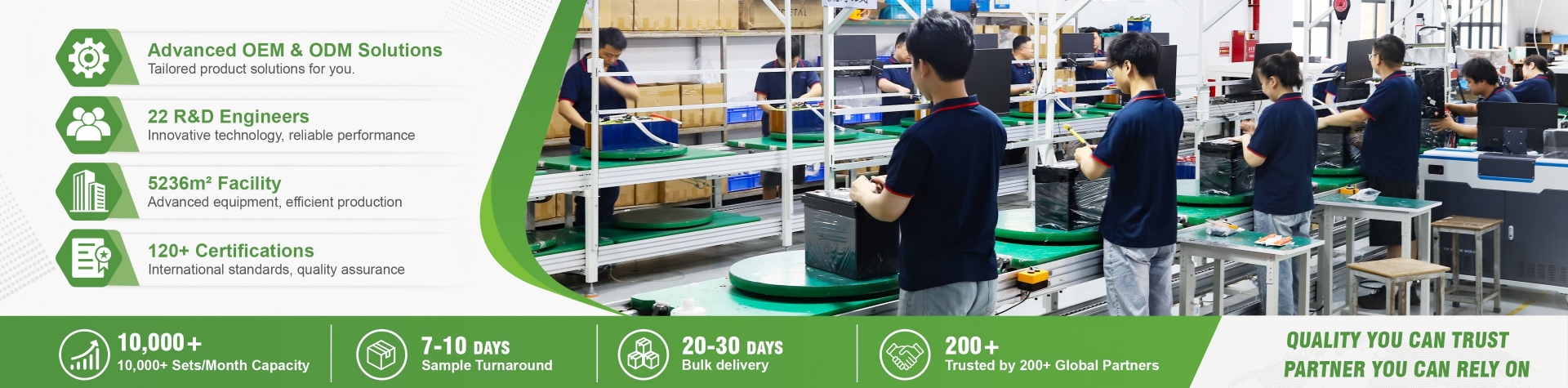
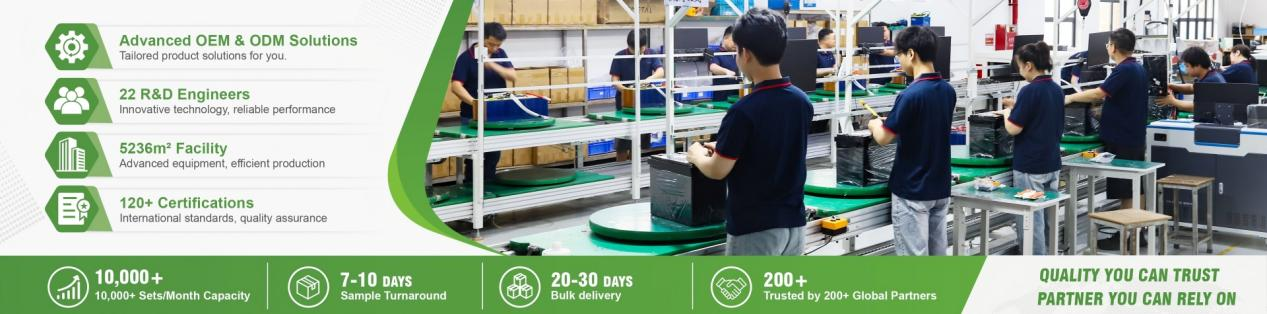
Consistent quality across an export programme needs production capacity behind it. Our lines run above 10,000 sets per month on standardised automated equipment, with laser welding, automated cell sorting and computerised aging tests in the process. Samples ship in 7–10 days and bulk orders in 20–30 days after deposit, supported by 8 senior R&D engineers and a patent portfolio of 2 invention and 22 utility model patents.
Compliance documents travel with the goods. UN 38.3 test reports and MSDS ship with every batch; CE and UKCA cover Europe and the United Kingdom, IEC 62619 is available for industrial applications, UL listings for the US market, RCM for Australia and New Zealand, and PSE for Japan. Certificates are held by the factory, and where a program needs a specific certification for a target market, we arrange it as part of the project rather than leaving it to the importer.
Flexible Customisation and Collaborative R&D Partnerships
Product differentiation is the reason most overseas partners come to a manufacturer instead of a catalogue. Customisation covers what matters commercially:
●Voltage and capacity from 12V to 72V and 5Ah to 628Ah.
●Case dimensions built to the customer’s battery compartment.
●Interfaces and hardware, including Anderson connectors, XT90 plugs, through-terminals and RJ45.
●Communication, including bespoke CAN maps for a customer’s own control panel.
●Special functions, such as low-temperature heating films and branded app interfaces.
●Branding and packaging, from laser-etched logos to localised manuals.
Technical proposals are returned within 24 hours, sample orders start from a single set, and small-batch programmes run from about 50 units — enough to test a segment without committing a container.
The next step for us is a complete 12V RV power system: battery, inverter, MPPT solar controller, central control display and DC-DC alternator charger, all designed to work together. The point is not the parts list. It is that one manufacturer owns the communication between all of them, so the system arrives with a single drawing package and one warranty counterparty instead of six suppliers each pointing at the others.
Looking Ahead
Mobile energy storage is moving toward more energy in the same space, higher system voltages, and better integration with the vehicle. As more RV builders take gas out of the coach and move cooking and heating onto electricity, 48V systems stop being an upgrade and start being the default — a 3,000VA inverter draws roughly 60A from a 51.2V bank against about 235A from a 12V one, and cable size alone settles the argument.
For distributors and brand owners, the practical question is whether a supply partner can keep up with that shift. Ours is a factory answer rather than a marketing one: the cells, the BMS firmware, the case tooling and the certifications are all in the same building.
To review the RV battery range, request a drawing package or discuss a custom programme, visit odipie.com.
Post time: Nov-03-2026


