
A quotation describes a product. An OEM relationship depends on what it leaves out: the process behind the pack, the paperwork that follows it, and whether anyone answers the phone in year three. Four quotes can look identical–12.8V 200Ah, Grade A cells, 36-month warranty, a bold cycle-life number, 18% below your price and still tell you almost nothing checkable. Price is easy to compare because it is the only part written down properly.
Who owns the spot welder
Every supplier calls itself a factory. Ask a technical question on a video call and watch where the answer comes from. If the person turns to someone off-camera, you are talking to a sales office. Trading companies can be good, but they fail differently: a trader cannot approve a firmware change without forwarding it up a chain for a week.
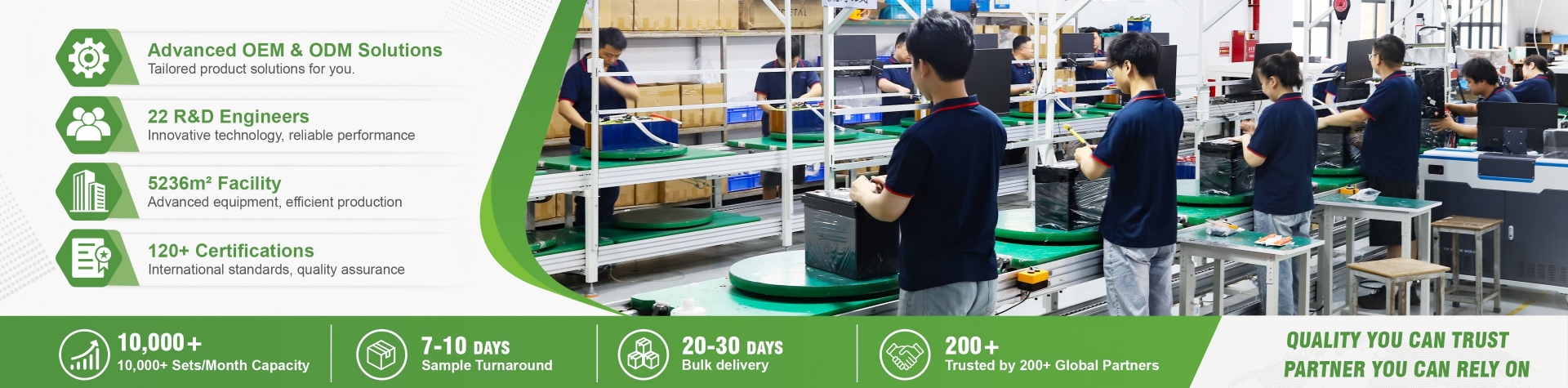
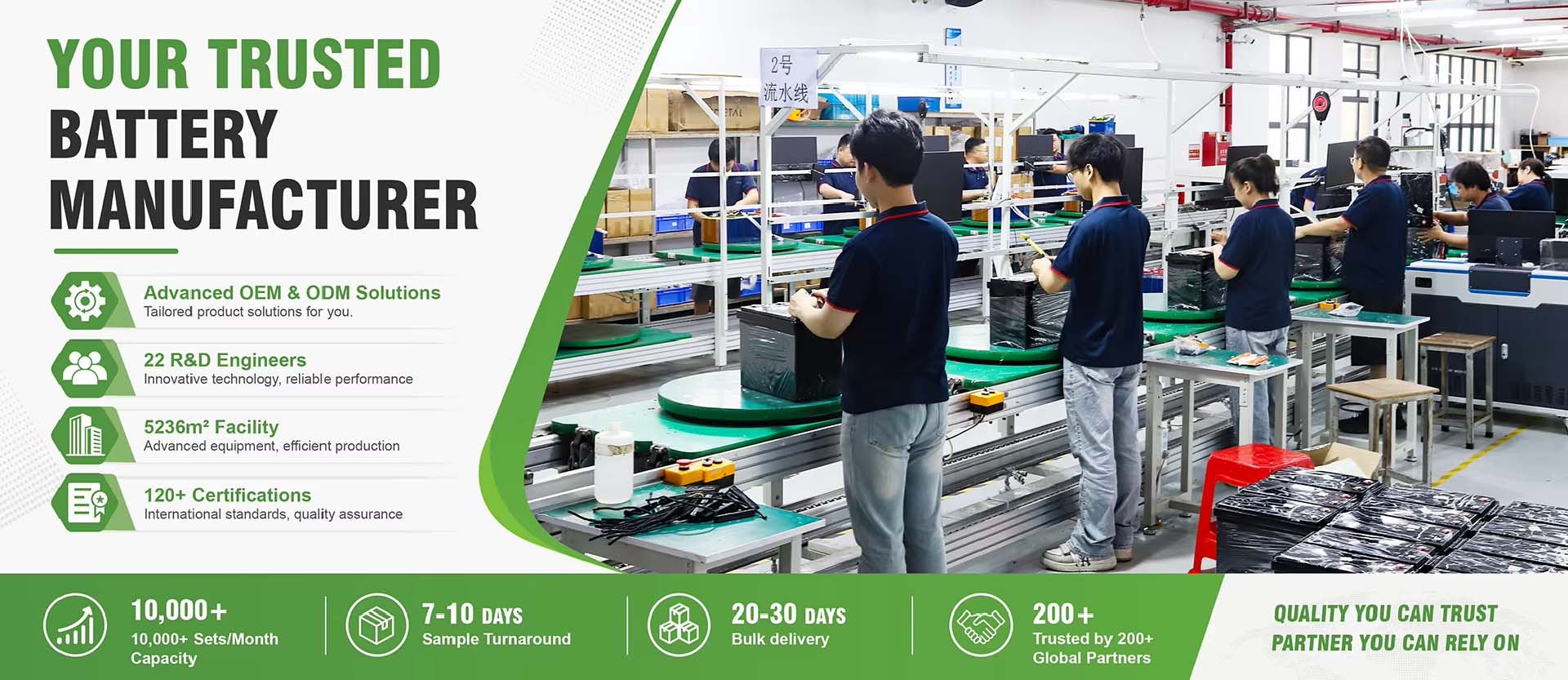
Two questions separate them. Send the working instruction for the quoted model with its revision number. We write an SOP for every model and operators work from it; it is a live document, not a PDF made for a visit. Then send the burn-in record for the last lot. Every pack spends hours on an aging rack, and that is the step that shortens when the workshop is busy. We run eight aging cabinets, two each of finished-product testers, vibration tables, thermal chambers and laser welders across four automated lines, about 500 packs a day. Those numbers mean little alone; they matter because you can ask to see the records. Ask who supplies the cells, too. Ours come from EVE, Gotion, REPT, SUNWODA and CALB under agreements rather than spot purchases—the difference between being in the queue in a tight quarter and at the back.
What a failed batch costs
“Grade A” is on every brochure, including ones putting Grade B in a Grade A box. Behaviour around failure is more useful. Incoming cells are inspected before warehouse entry; a failed lot goes back as a lot, not as a discount negotiation. Patrols cover every station during the run. Every finished unit is tested item by item, not sampled, then aged until standard aging reaches 100% of design capacity, or 95% on the fast profile, with channel data retained.
The failures that damage a brand are rarely manufacturing failures. They are substitutions: a cell model changes because a supplier is short, a BMS board moves to a newer revision, a terminal becomes cheaper. The pack on the pallet is 97% the product it was three months ago. Three percent is enough. A change should need written approval before it happens, and you should hear about it from the factory, not your customer. No plant tests its way to zero defects; the ones claiming otherwise have stopped measuring. You are buying a process that catches failure before the pallet ships, plus a paper trail when it doesn’t. One Australian battery brand has ordered six or more times a year since 2021 across marine and golf-cart models. Repeat orders at that rate are a process statistic before a sales one.
Where a good pack fails in the van
On a bench, a pack charges and discharges all day. Put it in a vehicle with an inverter, MPPT controller, DC-DC charger and a monitor on a data bus, and the interesting failures start.
Current first: a 3kW inverter on a 12.8V bank pulls about 235A, and asks for more for a heartbeat when a compressor starts. Size the BMS against the pack’s nominal rating instead of the inverter’s surge and you build a battery that trips when the fridge kicks in. He rings the brand, not the factory.
Cold second: LiFePO4 should not be charged below zero—fine in Queensland, less fine in Norway. Self-heating answers it. On most of our range it is an option; the largest 12.8V pack carries it as standard. Selling into Scandinavia or inland Canada makes that a line item, not a footnote.
Protocol third, and the most under-specified. We build CAN, RS485 and RS232. The useful question is not whether a pack “supports Victron,” but which inverter and monitor this exact model was tested against, on which firmware, and whether the protocol document ships with the order. Compatible should mean two devices sat on a bench until something happened. Often it means both ends speak CAN and nobody checked.
A fourth is a build decision: a hardware BMS keeps thresholds in circuitry and stays as built—what distribution wants. A software BMS exposes thresholds as parameters, so charge limits, balancing and fault logic can be rewritten for one machine. An OEM project usually needs the second. They are different products, not trim levels.
Somebody cut that hole before you arrived
Compartments are designed before anyone knows which battery goes in. A wheel arch eats a corner; a bed base fixes ceiling height. Our catalogue has a 61mm case because a customer’s tray sat under a base that wasn’t moving, and nothing standard fitted. The ultra-slim sheet-metal series runs 61 to 82mm thick with mounting ears at the corners, since a 30kg pack needs fixing to something structural, not strapping to a shelf. Terminal position, bracket layout and cable exit move with the drawing—and the drawing decides whether a project is cheap or expensive six months later.
Before tooling, get two things straight. The 25.6V 230Ah, 280Ah and 314Ah models are IP65; the 12.8V range is IP67. A sheet claiming IP67 across an entire catalogue deserves a question, not admiration. And cases have tolerances. Get them in writing; a millimetre decides whether the pack drops into the tray or an hourly-paid installer shims it.
A certificate is worth the model number on it
Certification is marketed as logos. In practice it is a matching exercise between a document and a configuration. We hold CE, UKCA, RoHS, REACH, FCC, IEC 62619, UN38.3, MSDS, sea and road transport identification, an EU 2023/1542 declaration of conformity and ISO 9001. Few factories lack certificates. What goes missing is the link between certificate and box: last year’s report shipped against this year’s build because the BMS changed and nobody re-tested.
Compare two dates: the report date and the date your build was specified. Then check which model numbers appear on the certificate, not which product family it belongs to. One legal point: after private label, whose name is on the label as manufacturer, and who answers if a market surveillance authority writes? Settle that before the first PO. It is a dull conversation in October and an expensive one at a border in March.
Differentiation, MOQ, warranty, and what we can’t do
Private label is a sticker, and a sticker changes nothing a customer can hold. He can hold the case, terminal layout, app, whether the pack heats itself on a frosty morning, what the dealer sees when the carton opens. We build 12V to 72V and 5Ah to 628Ah, customise enclosure dimensions, offer Anderson, XT90, stud and RJ45 interfaces, custom colours, logo, material and finish, hardware or software BMS work, self-heating, app customisation, and custom cartons, crates, labels and manuals. The cell inside is a commodity. A brand whose only difference is the logo is buying a commodity and will be priced like one. Margin survives in the interface and enclosure: the pack that fits a compartment nobody else fits, or talks to a controller nobody else talks to. That is engineering work, and it is the part a manufacturing partner can genuinely do.
MOQ is a cost, not an insult. A five-piece custom run consumes the same engineering hours, tooling setup and line changeover as a five-hundred-piece run. A supplier quoting a cheerful MOQ of 20 on a new enclosure has either failed to cost it or will recover it somewhere you haven’t looked. Staging can move: one new model at a time, sample first, then a small batch against a rolling forecast rather than a single PO. Our figures: stock items ship in about three days, custom builds in twenty, rush orders in seven. Standard finished goods carry 200 pieces of safety stock per model; custom programmes keep cells, BMS and cases on the shelf and build in seven. Cells land in ten days under supply agreements, BMS in seven, plastic cases in three, custom metal in ten, non-standard parts in fifteen. Season matters. RV battery demand is not flat; a supplier that hasn’t built stock in the shoulder months will be short in June.
Warranty is where a cheap supplier turns expensive, and the clause is only half of it. Ours runs 36 months from shipment: capacity not mislabelled, original Grade A cells, degradation above 10% a year or 20% within three years treated as a defect and verified by a third-party lab at 25±2°C. Exclusions are written down, not implied. The other half is week one of a problem. Bluetooth and remote diagnostics clear a decent share of “the battery is dead” calls without anything entering a courier’s van—the only support model that works across an ocean at sensible cost. When it doesn’t clear, the options are replacement, credit against the next order or refund; freight should be named in the agreement instead of negotiated during the argument. Ask for a failure analysis report from any real case they will share. A useful one names a component: cell, BMS, harness, or the installation. One that concludes “usage issue” is a polite refusal.
We can’t turn a commodity pack into a premium product. If the positioning rests on the battery alone, no factory will rescue it. We can’t warrant an installation we never saw; most field failures trace to cable gauge, crimp quality, charger settings or a shunt wired on the wrong side of the negative. That belongs to the installer and the manual. We can’t be cheapest, fastest and most attentive at once. Two of three is achievable. Anyone offering all three in a first email is a trader with nothing to schedule. And we shouldn’t say yes to everything: a factory that accepts a new enclosure, new protocol and new terminal layout in one reply without asking a question hasn’t understood the request.
Eight questions worth more than a factory tour
1.Which cell brands and grades, and can I see the incoming inspection record for my lot?
2.What aging profile does every unit run, and what is the pass threshold?
3.Who signs off a cell or BMS change, and when am I told?
4.Which inverters and monitors has this exact model been tested against, and does the protocol document come with it?
5.Which certificate covers this model number, and what happens when we change the BMS?
6.What is the dimensional tolerance on the case, and can I see the drawing before tooling?
7.What does the warranty clause say in numbers, and who pays return freight?
8.What does a 50pieces trial cost, all in, including tooling and a second sample round?
If you are specifying a house bank or private-label range for the coming season, send the compartment drawing and load list first. Those two documents decide the pack. Send a target price instead and you’ll get a pack that meets the price.
0DIPIE is the brand of Shenzhen Lead New Energy Co., Ltd., a manufacturer of LiFePO4 packs for RV, marine, golf cart and residential storage, and sodium-ion packs. Founded 2021, 5,236m² plant in Dongguan, 75 staff, eight senior R&D engineers, two invention patents and 22 utility model patents, more than 60,000 packs exported a year to the EU, UK, North America, Australia and Japan. CE·UKCA·RoHS·REACH·FCC·IEC 62619·UN38.3·MSDS·sea and road transport identification·EU 2023/1542 declaration of conformity·ISO 9001.
Post time: Nov-11-2026


