
Ask anyone building caravans or camper conversions what changed in the last few years and you get the same answer: the load list grew, and the battery compartment didn’t. House banks that used to be 100Ah are now quoted at 300, sometimes 400. The cavity beside the wheel arch is the size it was in 2015.
For a manufacturer, converter or sourcing team, that turns the battery decision into a geometry problem long before it becomes a chemistry problem. And geometry problems are cheaper to solve on paper than in production.
Start with the envelope, not the amp-hours
Most specification work we see is lost before anyone opens a catalogue. Somebody shortlists packs by capacity and price, then finds out at the prototype stage that the winner doesn’t go through the service hatch.
Three habits that save weeks:
Measure the opening, not the cavity. A battery that fits the space but not the doorway is a paper battery.
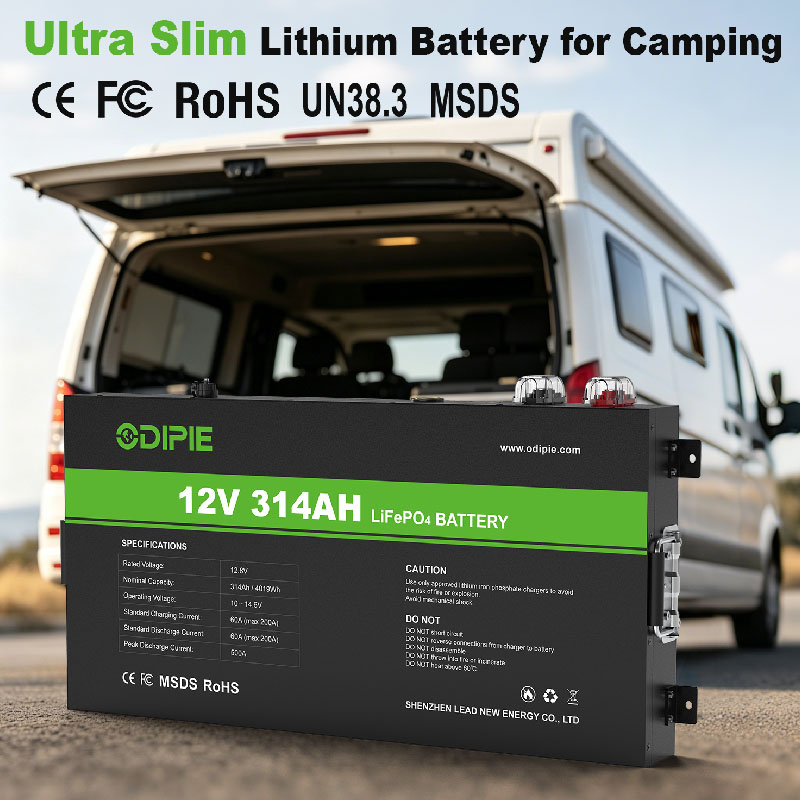
Measure with terminals included. On our slim-format 12.8V 314Ah pack the case is 730 × 370 × 82 mm; with the terminals on top counted, the height envelope is 400 mm. Those last 18 millimetres decide whether a floor plan works.
Leave room for cable bend radius. A 200A continuous run needs short, thick cable, and thick cable doesn’t do sharp corners. If the terminal sits flush against a bulkhead, whoever installs it will improvise, and improvised installations are where warranty claims come from.
One detail that matters more to buyers than it looks: our 280Ah and 314Ah packs share the same case. Same cut-out, one tooling iteration, two capacity options on the order sheet. If you’re committing a mould or signing off a floor plan, that’s two trim levels covered by one battery bay.
Flat changes which locations are viable
The conventional RV battery is a box — tall, and demanding a box-shaped home. Tall cavities are scarce in a caravan. Flat space is not.
At 82 mm, a 4,019Wh pack goes under bed slats, into wheel-arch lockers, into the shallow void behind a wall panel. Positions that were never candidates become candidates, which in practice means the battery can sit where the weight should go rather than wherever there happens to be room.
The mechanical side is short to state: steel mounting flanges on the case, so it bolts down without straps or compression bars; sheet-steel enclosure rather than plastic, because locker floors and chassis rails see vibration, gravel and the occasional hose-down.
Two constraints still apply, and they belong in your installation drawing, not in the installer’s head. Terminals up, always. And leave a hand’s width of access for a spanner — a design that forces the battery out to torque a nut will be remembered, for the wrong reason.
The rest of the slim range
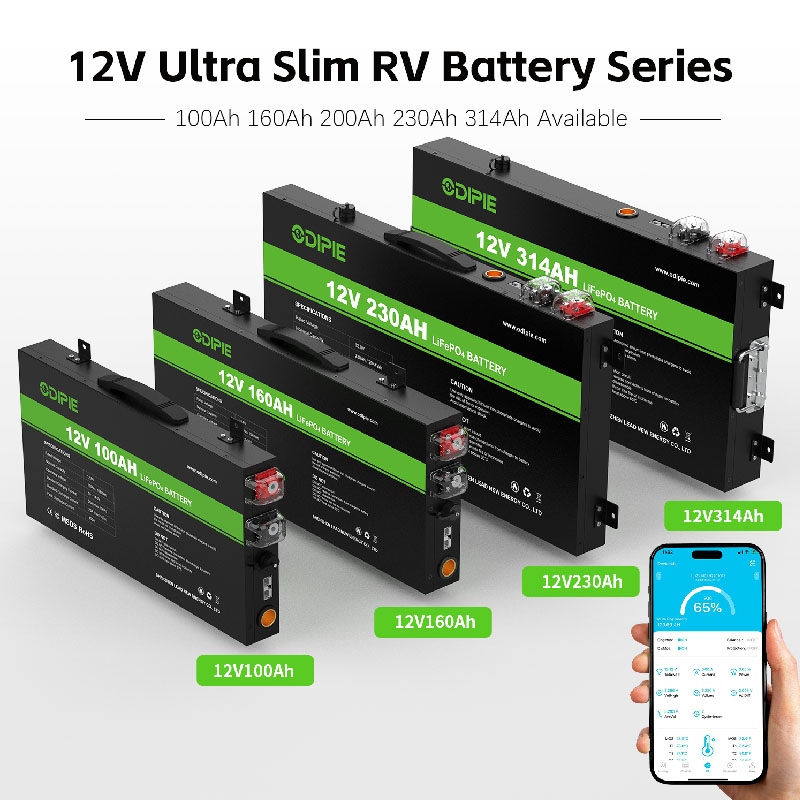
Five capacities, one family — same sheet-steel case, same flanges, same Bluetooth readout. Only thickness, envelope and stored energy change.
| Model | Energy | Case (W × H) | With terminals | Thickness | BMS max continuous |
| 12.8V 100Ah | 1,280Wh | 540 × 278 mm | 278 mm | 61 mm | 100A |
| 12.8V 160Ah | 2,048Wh | 640 × 273 mm | 273 mm | 69 mm | 150A |
| 12.8V 200Ah | 2,560Wh | 730 × 370 mm | 400 mm | 62 mm | 200A |
| 12.8V 230Ah | 2,944Wh | 730 × 370 mm | 400 mm | 62 mm | 200A |
| 12.8V 314Ah | 4,019Wh | 730 × 370 mm | 400 mm | 82 mm | 200A |
The 61 mm and 69 mm packs go where nothing else does: seat bases, sidewall voids, the shallow gap behind a panel. The 200Ah and 230Ah share one shell, so a single cut-out covers two tiers at 62 mm; 280Ah shares the 314Ah case if you want a step between them.
The 314Ah is the one we’d lead with — 4,019Wh in 82 mm, 200A continuous, 500A peak.
Heat: the number most spec sheets bury
Cycle life is rated at 25°C. A battery compartment on a sun-facing sidewall in a Gulf summer is nowhere near 25°C. Every LiFePO4 chemistry loses cycle life as temperature rises — physics, not a brand weakness — so the fair comparison between suppliers isn’t the headline figure, it’s the derating curve behind it.
If your program targets UAE, Saudi or Oman, ask for two things before you sign: rated cycle life at 35°C and 45°C, and the maximum charge temperature.
The charging window has an upper limit as well as a lower one. Our packs charge between 0°C and 55°C. Hot-climate compartments need airflow, and distance from whatever else exhausts heat into the same cavity — a fridge compressor duct is a popular neighbour and a bad one. The lower limit matters less in the Gulf and a great deal in alpine and northern-European programs, where a standard pack will refuse to charge below freezing. By design. If your range crosses both climates, settle the heating option at specification time, not after the container lands.
Four things to settle with the factory before the PO
Short list, in the order they usually become expensive:
Certifications and shipping files. UN38.3, MSDS, CE, FCC and RoHS ship standard with this series. Your forwarder and market-access team will need them; the expensive moment is discovering they’re missing after the booking.
Mechanical drawings, not renders. Engineering-led accounts work from 2D drawings with mounting-hole positions. A supplier who can’t produce them hasn’t served B2B before.
The nameplate. If you’re running a private label, brand, model numbering and rating prints are set up at the first order far more cheaply than retrofitted at the fifth.
Bluetooth readouts. Every pack in this series reports state of charge, voltage, current and fault codes to a phone app. Price it as support cost, not as a feature: a dealer who can read a fault code over the phone settles a call in one go, instead of a bench test, a return and a freight bill.
Where the other four fit
The 314Ah is the flagship, not the answer to every bay. How we’d spec a range:
100 / 160Ah — the shallow tier. 61 mm and 69 mm go into seat bases, sidewall voids and 4WD auxiliary bays. Also your entry price point.
200 / 230Ah — the volume tier. 2,560Wh and 2,944Wh at 62 mm, 200A behind them, enough to run an inverter. Same shell, so one bay design carries both.
314Ah — the top tier. 4,019Wh, 82 mm, 500A peak. Long off-grid stays, air conditioning, fleet and project builds where the brief is maximum energy in the space available.
Building a range rather than filling one order? Pair 200/230Ah with the 314Ah — one compartment design, three capacity tiers — and keep 100/160Ah for the shallow positions.
Looking for Slim LiFePO4 RV Batteries?
Contact Odipie for factory-direct pricing and OEM/ODM solutions.
Request a Quote Today →
Post time: Oct-28-2026


