

What changes with Odipie’s upgraded Smart BMS
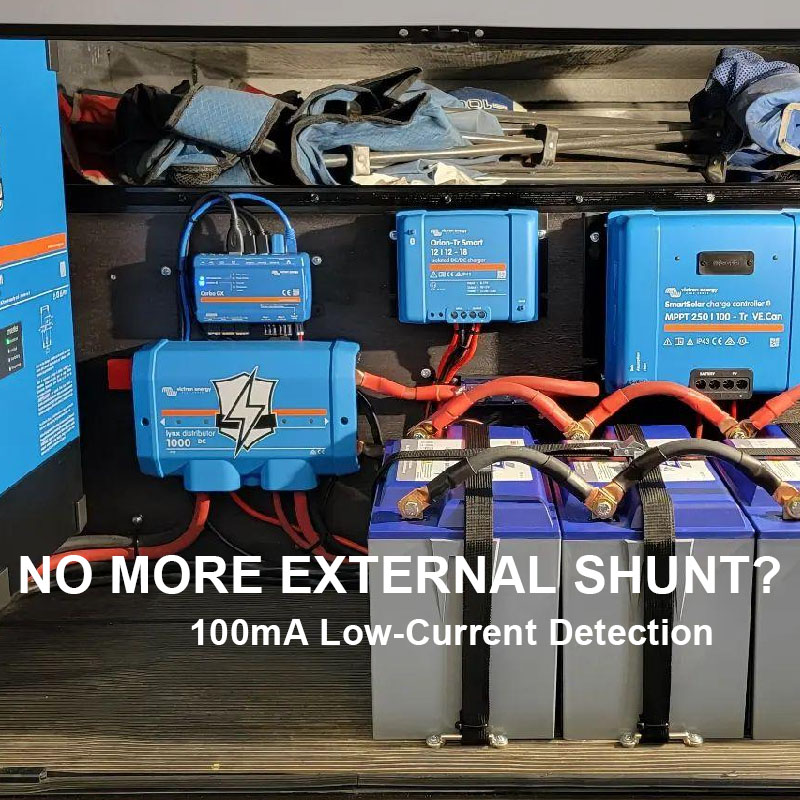
Ask an RV owner what they want from a battery monitor and the answer is short: how much is left, what the appliances are pulling, how long the bank will last. Nothing exotic. The awkward part sits with integrators and battery manufacturers — delivering those numbers without adding components the system does not need.
For years the default answer was an external shunt. Measure the current, calculate state of charge, job done. Battery management has moved on since.
Odipie has upgraded the Smart BMS in its RV and marine LiFePO4 batteries. It now detects discharge currents as low as 100mA (0.1A), and it supports Victron communication protocols. Put the two together and monitoring gets simpler; in a compatible system configuration, the additional external shunt may not be needed at all.
So why does any of this matter on a real install? And what practical difference does it make to an RV or marine electrical system?
1. How the external shunt ended up in RV and marine systems
A shunt is a precision current-measuring device fitted in the negative circuit of a battery system. It reads the very small voltage drop across its terminals to work out what is flowing into and out of the battery. That is the whole mechanism.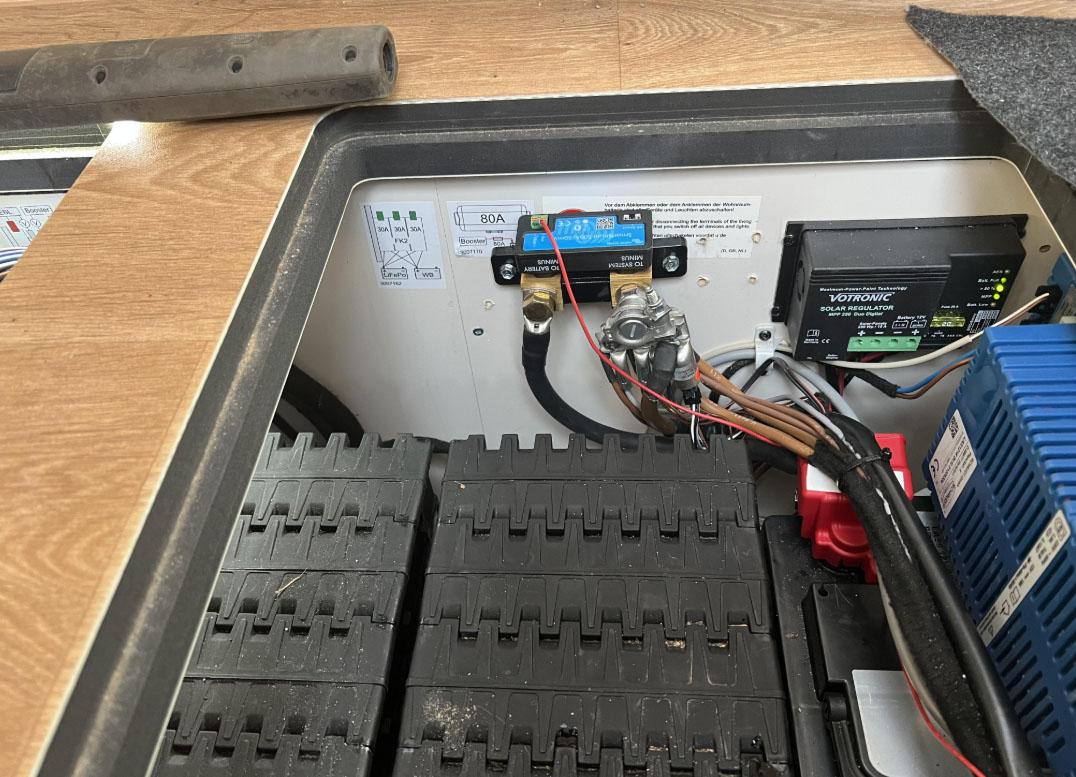
In a typical RV or marine installation, one shunt is watching current from several sources and loads at once:
- · Inverters and DC electrical appliances
- · Refrigerators and air conditioning systems
- · Solar charge controllers
- · DC-DC chargers
- · Shore power battery chargers
- · Other standby and auxiliary electrical equipment
Add up the current going in and coming out, and a battery monitor can estimate remaining capacity and calculate the battery’s state of charge.
LiFePO4 is where that earns its keep. Unlike lead-acid, a LiFePO4 battery has a relatively flat discharge voltage curve; voltage stays inside a narrow band through much of the discharge cycle. Voltage alone, then, is generally not enough to read remaining capacity accurately.
That is why external battery monitors such as the Victron SmartShunt and BMV series products became common components in many RV and marine electrical systems.
Every extra shunt, though, is another component, more wiring, installation work and configuration to get right. For battery brands and electrical system integrators turning out standardized or customized RV and marine power systems, fewer of those requirements means a more straightforward install.
2. Why low-current detection matters on LiFePO4
One detail in battery monitoring is easy to miss: low-current discharge.
Plenty of RV and marine devices keep consuming small amounts of electricity even when they appear to be switched off. The list usually looks like this:
- · BMS standby consumption
- · Bluetooth monitoring modules
- · Communication devices
- · Control panels and display systems
- · Inverter standby circuits
- · Alarm systems and security equipment
- · Other continuously connected electronic devices
On their own, each of these loads may use very little. Leave several connected for extended periods, though, and the combined consumption can become significant.
Take a continuous 100mA discharge: roughly 2.4Ah per day, 16.8Ah over seven days. On a 12.8V 100Ah LiFePO4 battery that is approximately 16.8% of nominal capacity — assuming it keeps drawing at that rate and nothing is charging the bank.
That is the case for low-current detection. If a monitoring system cannot accurately detect small discharge currents, some of that consumption may not be properly reflected in its current measurements. Over time, that can affect the accuracy of calculated remaining capacity.
Off-grid RV owners, and boat owners who leave the vessel unattended between trips, are the ones who feel those small but continuous demands most.
3. 100mA: what Odipie changed in the Smart BMS
Odipie upgraded the Smart BMS used in its RV and marine LiFePO4 battery solutions to improve battery monitoring performance. One of the key improvements: it can identify discharge currents as low as 100mA (0.1A).
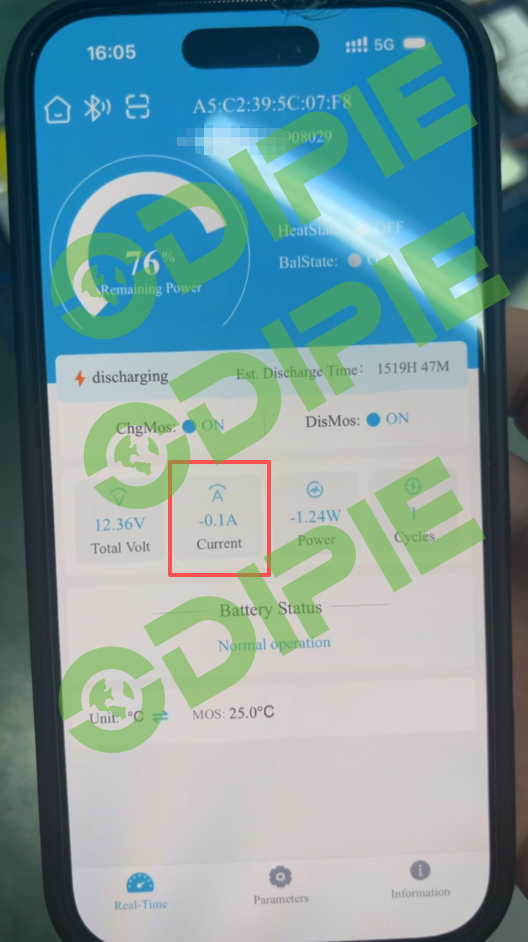
Small draws that conventional battery monitoring arrangements often overlook become visible. Which matters most when the main appliances are off but the electronics are still connected to the battery.
Park an RV for several days and its monitoring equipment, control modules and other standby electronics may continue consuming power. The upgraded BMS can identify that low-level discharge and provide more detailed information about battery operation.
For battery system designers, low-current monitoring can be handled more effectively inside the battery management architecture, rather than relying solely on an additional external measuring device.
One distinction worth keeping straight: current detection is not overall SOC accuracy. Accurate battery capacity estimation also depends on BMS measurement calibration, battery capacity settings, charge and discharge synchronization, and other operating parameters.
Even so, improving low-current detection is an important step toward more comprehensive battery monitoring.
4. Talking to Victron: where the battery data goes
Low-current detection is only one part of the upgrade.
Odipie’s RV and marine LiFePO4 batteries also support Victron communication protocols, so battery information can be exchanged with compatible Victron energy management equipment.
Victron Energy is widely used in RV, campervan, yacht and marine electrical systems. Its product ecosystem includes battery monitors, inverter/chargers, solar charge controllers, and centralized monitoring devices such as the Cerbo GX.
For system integrators, communication between the battery BMS and the rest of the electrical system is important. Depending on the supported communication configuration, battery information can be made available to compatible Victron equipment, helping the system monitor battery operating conditions and coordinate energy management.
Better Battery Data Visibility
Voltage, current, temperature, state of charge — relevant battery information can be communicated to compatible monitoring equipment according to the supported BMS communication profile.
Simplified System Integration
Communication between the battery and the wider energy system can reduce the need for separate monitoring arrangements and help create a more integrated installation.
More Convenient System Monitoring
RV owners and marine users can access relevant battery information through their compatible energy monitoring interface, rather than depending on multiple independent monitoring devices.
For OEM battery brands and electrical system integrators, communication compatibility is increasingly an important consideration when selecting a LiFePO4 battery supplier.
5. So, can you drop the external shunt?
Here is the practical implication worth paying attention to.
Conventional battery monitoring setups usually install an external shunt to measure all battery charging and discharging current. With Odipie’s upgraded Smart BMS, the battery can identify discharge currents as low as 100mA and communicate relevant battery information through supported Victron communication protocols. In a compatible system configuration, that may eliminate the need for an additional external battery shunt.
What that can buy you:
- · Fewer external monitoring components
- · Less negative-side wiring
- · Reduced installation complexity
- · Fewer additional accessories to purchase
- · A cleaner electrical installation
- · Potentially lower system integration costs
Whether an external shunt can be removed depends on the complete system architecture. The BMS must provide the required battery data, and the connected Victron equipment must correctly recognize and use that information. Some installations may also require an independent current monitor for additional measurement or troubleshooting purposes.
Integrators should confirm communication compatibility, monitoring requirements, and wiring arrangements before removing an existing shunt.
The point is not simply to remove a component. It is to achieve reliable battery monitoring with a simpler overall system design.
6. What this means for your RV and marine battery line
For RV and marine battery brands, distributors and OEM manufacturers, battery performance is only one part of the purchasing decision. System compatibility, installation requirements, monitoring capability and long-term reliability also influence supplier selection. An advanced BMS with low-current detection and Victron communication support can give businesses building their own battery products a genuine advantage.
For RV battery brands
A more integrated monitoring solution can keep product configurations simple and give RV electrical system integrators a better experience. Odipie’s RV batteries carry the upgraded BMS across 12.8V and 25.6V platforms, with 51.2V also available.
For marine battery brands
Boats and yachts often carry several electronic systems that stay connected while the vessel sits idle, and better low-current monitoring helps identify that small ongoing draw. Our marine batteries add enhanced water resistance, up to IP67, for onboard installations.
For RV and marine electrical system integrators
Fewer external monitoring components can simplify wiring and make installation planning more straightforward — provided the system supports direct BMS-based monitoring. It adds up.
For battery distributors
LiFePO4 batteries with advanced BMS functions and Victron communication support add technical selling points when you are working with professional installers and specialist dealers.
That matters most in markets where customers expect batteries to integrate with an established energy management system rather than run as a standalone product.
7. Odipie: LiFePO4 Battery Manufacturer for RV and Marine Applications
Odipie is the RV and marine battery brand of Shenzhen Lead New Energy Co., Ltd. We develop LiFePO4 battery solutions for professional applications, including recreational vehicles, campervans, boats and yachts.
As the manufacturer, we understand that capacity, dimensions, communication interfaces and system integration requirements differ from one customer to the next. Our RV and marine batteries are built to support a range of application requirements, with features including:
- · Advanced Smart BMS technology, with low-current detection down to 100mA
- · Victron communication protocol support
- · CAN Bus, RS485 and RS232 interfaces
- · Enhanced water resistance up to IP67
- · Customized capacities, dimensions and configurations
- · OEM and ODM manufacturing services
Whether you are developing a new RV battery product line, sourcing lithium batteries for marine electrical systems, or looking for an OEM manufacturing partner, Odipie can work with your team to evaluate suitable battery configurations.
Looking for a LiFePO4 RV or marine battery manufacturer with Victron communication support? Send us your voltage, capacity and compartment dimensions, and we will come back with a matching configuration, the datasheet and a quote.
Post time: Nov-03-2026


